Tip Rhinoplasty: What Nose Tip Surgery Can Change, Recovery and Limits
Tip rhinoplasty, also called tip plasty or nose tip surgery, focuses on the lower third of the nose. It can change the tip's projection, rotation and shape, but whether tip-only work is enough needs a wider assessment.
Yanhee Hospital describes tip-plasty with a cartilage graft for tip shape and projection. The American Academy of Otolaryngology guideline says rhinoplasty candidates should be assessed for nasal obstruction as well as their goals. Only a surgeon who assesses you can decide which operation you need.
Clinics cannot pay to be listed or ranked higher on AsiaPatient.
What tip rhinoplasty changes
Tip surgery concerns the end of the nose. A 2026 review by Alhajress and colleagues describes techniques that adjust tip projection and rotation, as well as shape.
These words describe different changes to discuss with the surgeon:
- Projection: how far the tip sits forward from the face.
- Rotation: the upward or downward angle of the tip.
- Width: how broad the tip looks from the front.
- Shape: the contour of the tip, including its roundness and symmetry.
Ask which of these the proposed operation would change and whether the bridge and upper bone structure would stay unchanged. Ask the surgeon to distinguish a change in tip width from a change in nostril width.
Concerns sources associate with the tip
Cleveland Clinic describes a bulbous or drooping tip among concerns that nose surgery can address.
Results may not be completely symmetric. The American Society of Plastic Surgeons (ASPS) makes that qualification in its rhinoplasty guidance.
When tip-only rhinoplasty may be enough, and when more may be needed
Ask the surgeon to explain whether the intended change can be achieved while leaving the bridge and other structures alone. The otolaryngology guideline describes rhinoplasty as potentially cosmetic, functional or both, with possible work on internal nasal structures.
A consultation should answer this: what would tip-only surgery address, and what would remain? Request that explanation before agreeing to a broader operation or assuming a smaller one will be sufficient.
A tip-focused concern isn't the same as a whole-nose plan
Yanhee distinguishes reshaping existing bone and cartilage from implant augmentation. It separately describes septoplasty as straightening a deviated septum, which may improve breathing.
The guideline says rhinoplasty may involve the septum, turbinates or nasal valves, structures inside the nasal airway. It recommends assessment for obstruction and conditions that could affect planning, including sleep apnea and bleeding disorders.
Questions to take to a consultation
Use the guideline's assessment scope to ask about your own plan:
Ask for the proposed procedure names in writing. Have the surgeon distinguish appearance goals from any breathing treatment.
How nose tip surgery is done
The Alhajress review discusses nasal tip reshaping, sutures and graft reinforcement. Sutures are stitches used to hold or reposition cartilage; a cartilage graft is a piece of cartilage added to support or shape an area.
Ask the surgeon to show where cartilage would be moved, removed or added. If the plan uses several techniques, ask what each one is intended to change.
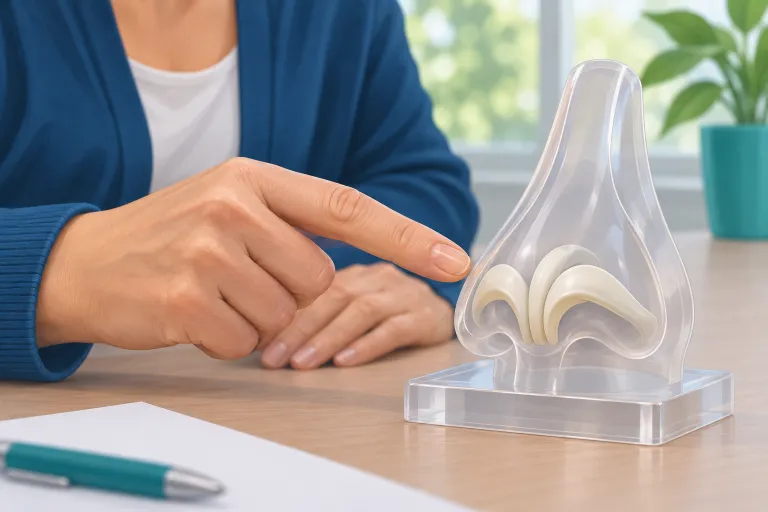
Cartilage-shaping techniques
The 2026 review compares two techniques. One divides the curved dome of the lower tip cartilage to adjust projection and rotation; the other combines limited cartilage removal with graft reinforcement.
The review examined five studies of these techniques. It rated evidence certainty low to very low because the studies largely looked back at previous operations and used differing populations and outcome measures. That limits confidence in comparisons between techniques.
When a graft may be part of tip work
ASPS says nose surgery sometimes requires cartilage grafts. It says cartilage most commonly comes from the septum, the partition inside the nose, occasionally from the ear and rarely from a rib.
Yanhee lists "Tip-plasty with graft" for tip shape and projection. Juthamas Clinic describes open ear- or rib-cartilage work for tips needing support, short noses, complex structural work and revision.
Ask where any proposed graft would come from, what it would support and what risks apply to the site where it is taken. The rhinoplasty in Thailand guide and its page on open versus closed rhinoplasty explain surgical access in more detail.
Tip rhinoplasty recovery: why the tip can take longest to settle
An ASPS article quoting surgeons says early recovery takes a few weeks, while full healing can take one to two years. It identifies the tip as the area that stays swollen longest, particularly after open surgery.

The same ASPS article says thick or oily skin, cartilage grafts and more extensive work may mean longer healing.
The Pavri study was one retrospective study of 40 primary open-rhinoplasty patients at Yale in the United States, published in 2016. It used three-dimensional measurements and excluded closed, secondary and cleft procedures.
| Stage | What the source says | Source type |
|---|---|---|
| First week | Sutures and splint commonly removed; bruises mostly resolved by about one week | ASPS surgeon-quoted article |
| Two to three weeks | Face looks and feels almost normal by two to three weeks | Yanhee hospital guidance |
| Six weeks | About half of swelling gone | ASPS surgeon-quoted article |
| Six months | According to the study's equation, 95% of edema resolves after six months | Same Pavri study |
| One year | According to the study's equation, 97.5% of edema resolves after one year. | Same Pavri study |
Its figures describe swelling after primary open rhinoplasty.
Aftercare and travel need a surgeon-specific plan
Phuket Plastic Surgery Institute (PPSI) instructs patients to use cold compression for the first three days and warm compression from day four. It advises avoiding heavy lifting and strenuous exercise for two weeks, with follow-up and suture removal five to seven days after discharge.
The ASPS tourism briefing suggests waiting seven to 10 days before flying after facial cosmetic procedures, explicitly including rhinoplasty. Ask your treating surgeon for individual flight clearance and the appointments you should attend before leaving.
For the fuller discussion, see rhinoplasty recovery in Thailand. Request a written aftercare plan and a contact for concerns after returning home.
Risks and revision figures
The ASPS patient brochure lists bleeding, infection, poor healing, sensation changes and breathing difficulty among rhinoplasty risks. It also includes swelling, skin discoloration, unsatisfactory appearance and possible revision surgery.
ASPS's risk page describes septal perforation, a hole in the partition inside the nose, as rare. Additional surgery may be needed, and ASPS says correction may be impossible.
Ask which risks apply to the proposed tip work and any graft. Ask how the surgeon would assess a concern about breathing, healing or appearance after surgery.
What tip-technique studies reported
One 1999 US study by Constantian reviewed a cartilage-sparing tip-graft technique in 405 patients. The study group was 40% primary rhinoplasty (first operations) and 60% secondary rhinoplasty (repeat operations).
The study reported a 14% total nasal revision rate, with 6% undergoing tip revision. The series covered a six-year study period and a mix of first and repeat operations. These are results for that tip-graft technique.
The 2026 Alhajress review likewise rates its evidence low to very low. Ask the surgeon how closely any study they quote matches your proposed operation and whether it includes first operations, repeat operations or both.
Broader rhinoplasty revision figures aren't tip-only figures
One 2016 US study by Spataro and colleagues examined records for 175,842 septorhinoplasty patients in California, Florida and New York. Index operations occurred from 2005 to 2009, with at least three years of follow-up through 2012.
The study reported revision in 3.3% overall: 3.1% after primary surgery and 11.0% after secondary surgery. Its cosmetic-surgery subgroup had a 7.9% revision proportion, 340 of 4,289 patients.
These groups cover septorhinoplasty patients. For the fuller discussion of repeat surgery, see revision rhinoplasty in Thailand.
What Thai hospitals and clinics print about tip work
Ask each hospital or clinic to confirm which parts of its published rhinoplasty guidance apply to the operation proposed for you. Request separate dates for discharge, stitch removal and follow-up.
Yanhee International Hospital
Yanhee's nose-reshaping page lists general anesthesia and a one to two hour operation. Its stay labels differ: the summary says "2-night stay", while the body says one to two days.
The hospital's price list separately labels the hospital stay for tip-plasty with graft as "None". Ask which admission arrangement applies to your proposed operation.
Yanhee gives splint removal at four to seven days and follow-up usually within seven to 10 days on its nose-reshaping page.
Juthamas Clinic
Juthamas describes semi-open work as "Bridge plus simple tip refinement". It describes open surgery using ear or rib cartilage for structural support and more complex work, including revision.
The clinic's recovery schedule lists stitches out at two weeks, most swelling and bruising gone at two to four weeks, and the nose settling at about six to 12 months, especially the tip. These are Juthamas's rhinoplasty instructions; ask for the schedule for your operation.
Bangkok Hospital Headquarters and Kamol Hospital
Bangkok Hospital Headquarters describes ear, septal and rib cartilage on its augmentation page. That page advises cold compression for three days, keeping the nose dry for at least five days and avoiding nasal trauma for at least one month.
Kamol Hospital lists tip shortening, tip correction and drooping-tip correction. Its rhinoplasty guidance says a good idea of the final result may take up to four months, and the full outcome up to a year.
Kamol also lists infection, visible scarring and dissatisfaction among possible complications. Ask the surgeon to explain the risks and recovery of the exact technique being offered.
In this section: rhinoplasty in Thailand, alar base reduction rhinoplasty, Asian rhinoplasty, rhinoplasty in Bangkok, rhinoplasty before and after, rhinoplasty clinics in Thailand compared, what rhinoplasty costs in Thailand, how long rhinoplasty results last, non surgical rhinoplasty, open vs closed rhinoplasty, rhinoplasty recovery, revision rhinoplasty, septorhinoplasty rhinoplasty and swelling rhinoplasty.
Frequently asked questions
What is tip rhinoplasty or tip plasty?
It is surgery focused on the nasal tip. The Alhajress review describes tip techniques addressing projection, rotation and shape; ask the surgeon which changes are planned in your case.
Can tip-only rhinoplasty be enough?
Ask whether your intended change can be achieved with tip work alone and what would remain unchanged. The otolaryngology guideline recommends assessing nasal obstruction before surgery, even when appearance prompted the consultation.
Can tip rhinoplasty fix a bulbous or drooping tip?
Cleveland Clinic includes both among concerns nose surgery can address. Ask whether the change you want is appropriate for tip-only surgery or would involve other structures.
Is cartilage grafting always needed for nose tip surgery?
ASPS describes cartilage grafting as something nose surgery sometimes requires. Ask why a graft is proposed, what it would change and what alternatives the surgeon considered.
How long does tip rhinoplasty swelling last?
The ASPS surgeon-quoted article says the tip stays swollen longest, particularly after open surgery. Early recovery takes weeks; full healing can take one to two years.
Does tip rhinoplasty affect breathing?
The otolaryngology guideline describes rhinoplasty as cosmetic, functional or both. Ask how the planned tip changes would affect your airway and whether any breathing treatment is proposed separately.
Read next
- Types of Rhinoplasty: Open, Closed and Other TermsUnderstand cosmetic, functional, open, closed, reduction and augmentation rhinoplasty, and what to ask about your surgical plan in Thailand.
- Male rhinoplasty: goals, structure and questions to askHow rhinoplasty planning differs for men, what to describe in a consultation, and the questions to settle before surgery in Thailand.
- Dorsal hump reduction: what nose-bridge surgery can changeWhat a dorsal hump is made of, how surgeons reduce it, why no fixed amount is safe to remove, and what to ask before surgery in Thailand.
- Nasal valve collapse surgery: breathing and rhinoplastyWhat nasal valve collapse is, how a clinician assesses it, how repair differs from septoplasty and rhinoplasty, and what the evidence cannot show.
Ask a Thai Surgeon Whether a Tip-Only Operation Is Enough
Tell us the procedure, your budget and your dates, and any hospitals you are considering.
Get My Free Quote →Free, no obligation. Nothing goes to a clinic without your OK.