Septorhinoplasty: Fixing Breathing and Nose Shape in One Operation
Septorhinoplasty is one operation that can correct the septum inside the nose and make cosmetic or structural changes to the nose, as ENT Health explains. It can address breathing and shape together, with the work planned around an assessment of both concerns.
If you're considering rhinoplasty in Thailand, ask the surgeon to describe the breathing work separately from the changes to appearance.
Clinics cannot pay to be listed or ranked higher on AsiaPatient.
What septorhinoplasty means
The nasal septum is the wall dividing the two sides of your nose. ENT Health says septoplasty corrects a deviated septum that causes significant breathing obstruction; septorhinoplasty adds cosmetic or structural nasal work.
Septoplasty alone, rhinoplasty alone, or both
| Operation | What it addresses | Question for your surgeon |
|---|---|---|
| Septoplasty | The internal dividing wall when its deviation causes significant obstruction, per ENT Health | Would treating the septum alone address my breathing concern? |
| Cosmetic rhinoplasty | Nose shape or size, per the UK National Health Service (NHS) | Which changes to appearance are proposed? |
| Septorhinoplasty | Septoplasty with cosmetic or structural nasal changes, per ENT Health | Which parts of the combined operation are planned for me? |
The American Academy of Otolaryngology guideline distinguishes septal work that doesn't affect nasal shape from rhinoplasty. Ask for the proposed changes in writing, rather than relying on the operation name alone.
Is functional rhinoplasty the same as septorhinoplasty?
The guideline says rhinoplasty can be functional, cosmetic or both. Functional rhinoplasty is intended to improve breathing. It may include work on the septum, turbinates or nasal valves, structures within the nasal airway.
Ask what your surgeon means by functional rhinoplasty in your case. Does the plan include septoplasty, and will it change the outside of your nose?
When a deviated septum and a nose job may be treated together
ENT Health describes combined work for significant obstruction from septal deviation and cosmetic or structural concerns. It also discusses septorhinoplasty after injury affecting breathing or nasal shape.
Ask an ear, nose and throat (ENT) specialist or rhinoplasty surgeon whether both parts need treatment. Explain what you want to change about breathing and what, if anything, you want to change about appearance.
What the assessment needs to separate
The guideline says clinicians should assess nasal obstruction and conditions that could change or rule out surgery. It names obstructive sleep apnea (blocked breathing during sleep), bleeding disorders and body dysmorphic disorder (distressing preoccupation with perceived appearance flaws).
The guideline also names long-term use of nasal medicines that narrow blood vessels. Ask how any relevant condition or medication affects the proposed plan, and discuss previous nasal injuries or operations.
The approach may be open or closed
Ask which approach the surgeon proposes and why. The open versus closed rhinoplasty guide covers the incision comparison.
An American Society of Plastic Surgeons (ASPS) recovery article quotes surgeons describing more tip swelling with an open approach. More extensive bone or cartilage work and grafts may also lengthen healing.
What happens during the operation
The NHS describes different reshaping methods: removing bone and cartilage for reduction, adding grafts for augmentation, or rearranging structures to change shape. Ask which of these, if any, will accompany the septal correction in your operation.
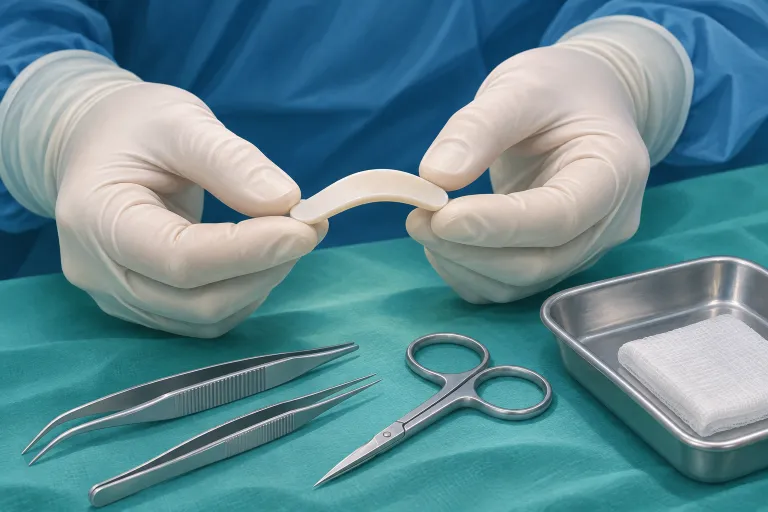
Cartilage grafts are pieces of cartilage added during surgery. ASPS says they most commonly come from the septum, occasionally from the ear and rarely from the rib.
Ask whether a graft is planned, where it would come from and why. Also ask which parts of the plan could change after the surgeon examines you in person.
Thailand hospital details to confirm
Yanhee International Hospital's nose-reshaping page describes "general anaesthesia", medicine that makes you unconscious for surgery, and a "1 to 2 hour operation". Ask which of its general rhinoplasty details apply to your combined procedure.
Yanhee's admission wording differs: its key-facts tile says "2-night stay", while its aftercare text says monitoring for "1 to 2 days" before discharge. The same page gives splint use of "4 to 7 days" and follow-up usually within "7 to 10 days".
Ask Yanhee to confirm the admission and follow-up schedule for your combined operation in writing.
Bangkok Hospital Headquarters lists rhinoplasty with reduction and septum correction with one hospital night. The offer is labeled "Fly in only" and valid until 31 December 2026.
Its terms print two inclusion lines. One lists operating and recovery rooms, supplies, operation medicine and the "surgeon team and anesthesiologist team only"; the other lists a standard inpatient room, nursing, food, equipment, supplies and operation medicine.
The same package terms exclude specialist consultation, implants, laboratory tests and other investigations. Medical clearance costs extra, as does treatment for underlying conditions or surgery-related complications.
Details to confirm before booking
Ask for a written plan that names your exact operation and anesthesia. Confirm hospital nights, follow-up appointments, splint or stitch removal, and who will handle concerns after you return home.
For prices, use rhinoplasty costs in Thailand. Ask the hospital to separate septal correction, external reshaping and any graft work in your quote, and explain the charges if further treatment is needed.
Septorhinoplasty recovery: the dates that matter
Discuss these milestones with the surgeon when planning your schedule. Ask for individual clearance for work, exercise and travel; the figures below describe different parts of recovery.
| Milestone | Source-specific timing |
|---|---|
| Splints and stitches | ENT Health says an external splint may stay five to seven days; internal splinting or packing, if used, is normally removed within the next week after surgery. The ASPS article describes splint and stitch removal in the first week after rhinoplasty. |
| Work or school | The ASPS article says most people can return after about a week. The NHS says you may need up to two weeks off work after nose surgery. |
| Exercise | The ASPS article describes mild exercise after two to three weeks and quotes advice to avoid strenuous exercise for at least six weeks. The NHS says you may be advised to avoid strenuous exercise or contact sports for four to six weeks. |
| Swelling and healing | The ASPS article describes about half the swelling resolved at six weeks and says full healing can take one to two years. The NHS says swelling may take up to six months to disappear. |
Healing might take longer with more extensive work, according to the ASPS article. For the fuller timeline, see rhinoplasty recovery in Thailand.

Flying home after septorhinoplasty
ASPS suggests waiting seven to 10 days before flying after facial cosmetic procedures, including rhinoplasty. Ask the treating surgeon how that general suggestion applies to your combined operation and planned flight.
When arranging the trip, ask which checks need to happen before departure. Request a contact for concerns after you leave and instructions for arranging care at home.
Risks, complications and further surgery
ASPS lists infection, altered sensation, breathing difficulty, poor healing or scarring, swelling, unsatisfactory appearance and possible revision surgery among rhinoplasty risks. It calls septal perforation, a hole in the dividing wall, rare; repair may need further surgery and may be impossible.
The NHS says any operation carries a small risk of excessive bleeding or an allergic reaction to anesthesia. Ask the surgeon which complications matter for your plan and how each would be treated.
What the revision-rate study covers
One retrospective US study by Spataro and colleagues, published in 2016, followed 175,842 septorhinoplasty patients in California, Florida and New York. Their operations took place from 2005 to 2009, with database follow-up through 2012 and at least three years of follow-up.
The study reported these revision rates:
- Overall: 3.3%, or 5,775 of 175,842 patients.
- Primary (first) procedures: 3.1%, or 5,389 of 172,324 patients.
- Secondary (repeat) procedures: 11.0%, or 386 of 3,518 patients.
The same study reported 7.9% revision among patients operated on for cosmetic reasons, or 340 of 4,289 patients.
Those figures describe revision surgery in that US cohort. Ask your surgeon how your operation and history compare with the patients included before using a published percentage to judge your own risk.
Why published rates shouldn't be mixed
Even within Spataro's study, the primary and secondary groups had different revision rates. Keep those groups separate when discussing the findings.
If you're given a complication percentage, ask which operation, country, patient group and follow-up period it covers. Ask whether it measures another operation or includes other problems, such as infection or breathing difficulty.
For further surgery after a previous nose operation, see revision rhinoplasty in Thailand.
Will insurance or public health funding cover the breathing part?
Ask for the functional and cosmetic parts to be itemized before requesting a funding decision. The US, UK and Australian sources below use different coverage wording.
United States
ASPS says rhinoplasty to improve breathing, most commonly because of an obstructed airway, is considered reconstructive and may be covered by insurance. That includes breathing surgery performed alongside cosmetic rhinoplasty.
ASPS says this requires a detailed examination to establish the cause of impaired breathing and prior authorization from the insurer. Ask which parts of your proposed operation the authorization covers.
ENT Health says surgery for breathing, major deformity or injury is frequently covered wholly or partly, while cosmetic surgery usually isn't.
United Kingdom
The NHS says nose reshaping isn't usually available for cosmetic reasons, but may be provided if needed to help you breathe. Ask your treating service which part of the proposed care it can fund.
Australia
Healthdirect says Medicare may cover rhinoplasty for a medical reason such as breathing problems. It says Medicare generally doesn't cover cosmetic nose surgery, and private health insurance often doesn't either.
Ask your surgeon and insurer which eligibility rules apply to the breathing work. For surgery in Thailand, ask explicitly whether the proposed overseas treatment is covered before making a booking.
Questions to take to an ENT or rhinoplasty surgeon
Use the consultation to get a written plan for both breathing and appearance. The American Academy guideline calls for discussion of expected appearance, breathing, complications and recovery.
In this section: rhinoplasty in Thailand, alar base reduction rhinoplasty, Asian rhinoplasty, rhinoplasty in Bangkok, rhinoplasty before and after, rhinoplasty clinics in Thailand compared, what rhinoplasty costs in Thailand, how long rhinoplasty results last, non surgical rhinoplasty, open vs closed rhinoplasty, rhinoplasty recovery, revision rhinoplasty, swelling rhinoplasty and tip rhinoplasty.
Frequently asked questions
Can septoplasty and rhinoplasty be done together?
Yes. ENT Health calls septoplasty combined with cosmetic or structural nasal changes septorhinoplasty.
Is septorhinoplasty the same as functional rhinoplasty?
Ask which procedures the surgeon means. The American Academy guideline allows rhinoplasty to have functional, cosmetic or combined purposes, with possible septal work.
Can a deviated septum and a nose job be fixed in one operation?
They can be treated together, according to ENT Health. Ask whether your assessment supports both septal correction and external reshaping.
How long is septorhinoplasty recovery?
Discuss your combined operation with the surgeon using the milestones above. For rhinoplasty, the NHS says you may need up to two weeks off work; the ASPS article says full healing can take one to two years.
How long should I stay in Thailand after septorhinoplasty?
Ask your surgeon for a departure plan based on your operation and follow-up appointments. Bangkok Hospital's combined reduction and septum-correction package lists one hospital night; ask separately how long you should remain nearby after discharge.
Does insurance cover septorhinoplasty?
It may cover the breathing work: ASPS describes possible US insurance coverage with examination and prior authorization, including when combined with cosmetic rhinoplasty. Ask your insurer to confirm the covered components and whether the Thai hospital and proposed operation qualify.
Read next
- Non-surgical nose job with fillers: what it can and cannot fixWhat a non-surgical nose job with filler can and cannot change, how long it lasts, the risks including blocked blood vessels, and how it compares with surgery.
- Alar base reduction: narrowing the nostrilsWhat alar base reduction changes, where the incision and scar sit, recovery and risks, and what Thai hospitals print about nostril narrowing.
- Tip rhinoplasty: reshaping only the tipWhat tip rhinoplasty changes, the cartilage and graft techniques, when a tip-only operation is enough, recovery, risks and revision figures from studies.
- Types of Rhinoplasty: Open, Closed and Other TermsUnderstand cosmetic, functional, open, closed, reduction and augmentation rhinoplasty, and what to ask about your surgical plan in Thailand.
Ask a Thai Surgeon Whether the Breathing and Shape Work Can Be Done Together
Tell us the procedure, your budget and your dates, and any hospitals you are considering.
Get My Free Quote →Free, no obligation. Nothing goes to a clinic without your OK.