Hair Transplant for Women: Candidacy, Techniques, Recovery, and Costs
One woman on r/FemaleHairLoss wanted a surgeon who understood diffuse thinning and density work. Her concern belongs early in any hair transplant guide: she wanted help with thinning across her scalp, beyond changing her hairline (r/FemaleHairLoss).
A hair transplant can help some women, but suitability starts with the diagnosis and enough healthy donor hair. The American Academy of Dermatology (AAD) says women with sparse hair across the whole scalp may not have enough healthy hair to transplant.
What a Hair Transplant Can and Cannot Do for Women
A transplant moves healthy scalp hairs into thinning areas, as the AAD explains. The area supplying the hair is the donor area; the area receiving it is the recipient area.
Before discussing how much hair to move, a doctor needs to establish why you're losing it. The AAD uses the cause of the loss to guide treatment. Your health and pregnancy plans also affect the choice.
We would ask for that diagnosis before comparing surgical quotes. A graft count alone doesn't answer whether surgery addresses your particular problem.
Start With Diagnosis: Types of Hair Loss and Why They Matter
Female pattern hair loss and diffuse thinning
Women with female pattern hair loss often have diffuse thinning across the top of the scalp and temples. A women-focused review by Queen and Avram describes this pattern and calls for assessment of underlying health contributors and other forms of hair loss.
Diffuse thinning describes how the loss is distributed. It doesn't settle whether you can have surgery: the AAD says a transplant may be an option for some women with female pattern loss, while hair that is sparse all over the scalp may mean there isn't enough healthy hair to transplant.
Traction alopecia
Traction alopecia is hair loss associated with repeated pulling from hairstyling. Billero and Miteva describe how continued traumatic styling can lead to irreversible scarring in later stages.
Their review also describes magnified scalp examination and tissue examination as ways to distinguish traction alopecia from other conditions. If you've lost hair around areas repeatedly pulled by a hairstyle, ask for that diagnosis before considering a transplant.
Scarring alopecias
Scarring forms of hair loss need a specialist discussion about the diagnosis, disease activity, and whether surgery is appropriate. A systematic review by Ekelem, Pham, and Atanaskova Mesinkovska found transplant reports for certain primary scarring alopecias, but the evidence covered only 34 patients across 15 reports.
The authors warned that favorable results may be more likely to get published. Ask the specialist what evidence applies to your condition and what would make them advise against operating.
A high hairline and hairline lowering
Wanting a lower hairline is a different starting point from wanting more density across a thinning scalp. The women treated in Civas et al. included both female pattern hair loss and hairline restoration cases.
Forehead reduction is another surgical option for a high forehead, reviewed by Vila et al. Ask the surgeon to explain which procedure they mean when they say "hairline lowering," because a transplant and forehead reduction involve different operations.
Hair Loss After Pregnancy or Illness: Do You Need a Transplant?
Not necessarily. The British Association of Dermatologists says telogen effluvium, a condition causing excessive scalp shedding, usually gets better without treatment. If this explains your thinning, ask your dermatologist whether to allow time for recovery before considering hair transplantation.
The AAD lists childbirth and illness among possible triggers. It says people often notice the extra shedding a few months after the stressful event, so mention recent health changes even if your hair seemed unchanged at the time.
For shedding after pregnancy, the AAD says most women recover their usual hair fullness by their child’s first birthday. That describes the usual course, not a deadline every woman will meet.
The AAD also notes that hair loss and excessive shedding can occur together. Ask your dermatologist which explains your current thinning and whether more than one cause needs attention.
Bring dates for when the shedding began and any preceding childbirth or illness. Before booking surgery in Thailand, ask what changes the doctor wants to see at reassessment and what would justify moving from observation to a surgical consultation.
Why Fewer Women Are Candidates for Hair Transplant
A stable donor area is the limiting factor
Healthy donor hair is a requirement whichever harvesting method you choose. The Follicular Unit Transplantation (FUT) Task Force of the International Society of Hair Restoration Surgery (ISHRS) warns that general thinning in the donor area may make someone unsuitable for any transplant surgery.
So ask this at the consultation: what did the examination show about the hair you would be donating? Ask the surgeon to explain the findings before agreeing on the amount to remove.
Diffuse thinning in the donor area
The concern is whether thinning extends into the area meant to supply the grafts. The AAD highlights this problem when hair is sparse all over the scalp.
A photo of your part or front hairline leaves that question unanswered. We would want the consultation to cover the donor area as carefully as the area you want filled.
When surgery may be deferred or unsuitable
The women-only study by Civas et al. selected patients with adequate donor capacity, realistic expectations, and no medical reason preventing surgery. Those conditions matter before choosing a technique.
So if the diagnosis is unresolved or the donor supply is inadequate, ask what assessment or treatment should happen next. A useful consultation should explain why the surgeon recommends proceeding, waiting, or declining surgery.
What a Proper Assessment Should Include
Diagnosis before a surgical plan
The AAD says effective treatment begins with finding the cause. Bring the diagnosis you have already received, along with any previous test results and treatment history.
If nobody has diagnosed the loss, make that the purpose of the appointment. Ask whether you need a dermatologist's assessment before a surgical plan can be made.
History, examination, and trichoscopy
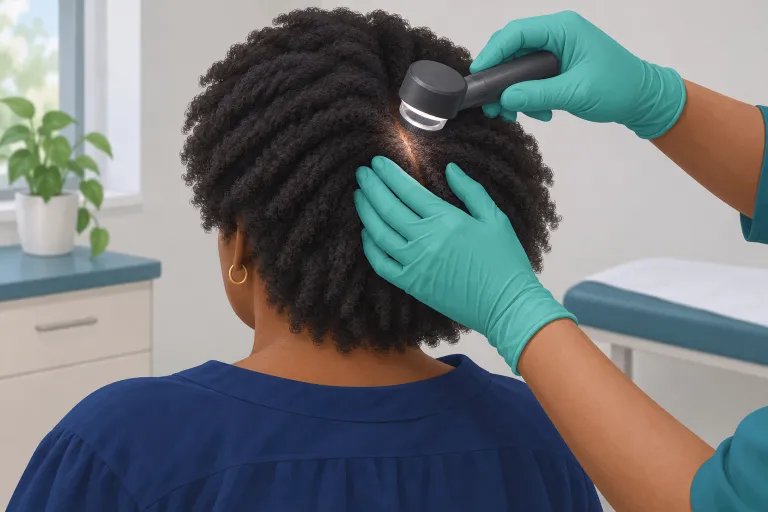
Trichoscopy means examining the scalp and hair under magnification. Civas et al. describe a work-up that includes medical and family history, tests of hair shedding, and trichoscopy.
Ask the clinician to show you what they see and explain how it affects the recommendation. The useful outcome is an explanation of your hair loss and donor supply, rather than a test name on a consultation sheet.
When a clinician may order blood tests
Blood tests aren't a fixed shopping list for every woman considering surgery. The AAD says tests or a scalp biopsy may be needed when the dermatologist suspects problems such as disease, a deficiency, hormone imbalance, or infection.
A scalp biopsy examines a small tissue sample. Civas et al. list it in the work-up when scarring alopecia is suspected, so ask what a proposed test is intended to clarify.
Donor and recipient-area assessment
The surgeon needs to assess both the available donor hair and the area receiving it. Your preferred hairstyle also belongs in the discussion: an ISHRS literature summary identifies donor and recipient evaluation, hairstyle, and occupation among the factors in choosing a harvesting method.
Explain what you want to change and how much trimming you could accept. Ask the surgeon to mark the proposed treatment area and explain how the donor findings support it.
If You Travel Abroad for Surgery
Traveling for a hair transplant means your care moves between two countries. Plan each step before you book, not after you land.
Treat a photo review as a first opinion
A plan from photos comes before anyone has examined your scalp. Trichoscopy and a donor-area check need you in the room.
So ask whether the in-person exam can change the plan, or stop the surgery.
Ask who will examine you and who will do each part of the operation. The ISHRS tells patients to ask who will evaluate their hair loss, who will be involved in the surgery, what role each person will play, and what training and licensing they have.
The NHS gives similar advice about cosmetic surgery holiday packages: make sure you have a consultation with the surgeon, not only with salespeople.
The NHS also advises two consultations with the surgeon treating you before any surgery, which gives you a cooling-off period. If you first meet the surgeon on the day of the operation, there is no gap between that consultation and the surgery.
Ask the clinic what happens, and what you would pay, if you decide not to go ahead after meeting the surgeon.
Know what the price covers
The CDC Yellow Book warns that some overseas clinics charge substantial fees for follow-up care on top of the base price.
So follow-up might cost extra. Ask whether it is in the quote, and whether it happens at the same clinic.
Plan the flight home around the clinic's checks
Ask what checks the clinic wants after surgery and when it says you can fly. Book the return flight around its answer.
The NHS tells people having cosmetic surgery abroad to plan when they can fly home, and says a holiday straight after surgery is unrealistic. Its advice is to rest, and to avoid alcohol, lying in the sun, sightseeing or going in the water.
Leave with your records and a doctor at home
Before you fly home, get copies of your medical records in English. The CDC Yellow Book asks doctors to remind medical travelers to request these records and to share them with anyone who sees them for follow-up.
Line up a doctor at home before you travel. The NHS warns UK patients that an overseas clinic may not have a health professional in the UK they can go to if a problem comes up.
Then get the remote follow-up details covered in the recovery section below: the clinic's contact, how it wants photographs taken, and when it will review you.
Techniques Used for Women
The harvesting method determines how the surgeon removes donor hair. The ISHRS FUT Task Force describes both FUE and FUT as current standard practices and says patients should hear the advantages and disadvantages of each.
| Method | How donor hair is taken | Shaving and scar trade-off |
|---|---|---|
| Follicular unit excision (FUE) | Individual natural groups of hairs are removed | Regional or full shaving may be needed; dot-like scars remain |
| Follicular unit transplantation (FUT) | A strip of scalp is removed and divided into grafts | Can avoid shaving; leaves a linear donor scar |
| Non-shaven FUE | Individual groups are removed without shaving the donor area | Avoids a full donor shave; some versions trim small sections |
The FUE and FUT comparison comes from Civas et al.; the non-shaven approach is described by Park et al.
FUE
In FUE, the surgeon uses small punches to remove individual follicular units, the natural groups in which hairs grow. ISHRS describes this as distinct from taking a strip of scalp.
Avoiding a strip doesn't mean avoiding scars. Civas et al. describe dot-like scars and the risk of donor thinning, which makes the extraction plan part of the decision.
FUT
With FUT, the donor incision is closed with stitches or staples, and the strip is divided into individual grafts. ISHRS describes this harvesting process.
The ISHRS FUT Task Force notes that many women may prefer strip removal to scalp shaving. You still need to consider the linear scar; our FUE vs FUT comparison explains the methods in more detail.
Unshaven and partial-shave FUE
Non-shaven FUE can omit donor-area shaving, as described in the case series by Park et al. Partial-shave FUE is another approach recorded in the ISHRS literature summary.
So ask which areas would be trimmed and how much hair would remain. "No shave" is too little detail to decide whether the proposed procedure fits your privacy concerns.
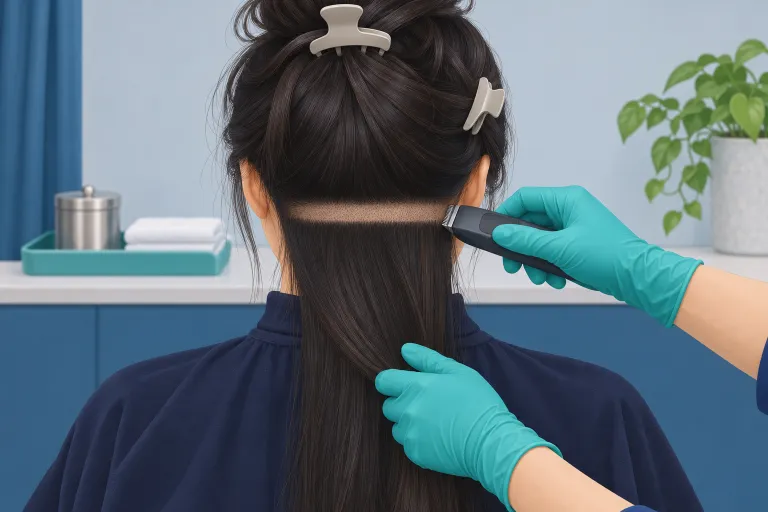
Bangkok Hair Clinic describes non-shaven FUE as more time-consuming, with more challenging wound care afterward.
Hairline lowering surgery versus a hairline transplant
Forehead reduction lowers the existing hairline surgically, while a transplant places donor hairs into the planned hairline area. The forehead-reduction review by Vila et al. covered eight retrospective studies involving 882 patients.
Reported complications included temporary or permanent hair loss, unacceptable scarring, persistent altered sensation, and a collection of blood under the skin. Ask how those risks compare with the proposed transplant in your case, rather than assuming the two procedures are interchangeable.
Graft Planning and Cost Research
In one 2025 retrospective series of 62 women, the median graft count was 1,700. That figure describes the patients treated by Civas et al., whose reasons for surgery included female pattern loss, hairline restoration, eyebrow transplants, and scar repair.
So don't use it as a target to request at consultation. Ask how the proposed number relates to your treatment area, existing hair, and assessed donor capacity; our graft planning guide explains the planning questions.
A poster on r/HairTransplants put the concern this way: "I would like to make sure that the amount of grafts that are being transplanted are not going to be wasted." Ask the surgeon to show where the planned grafts would go and why that distribution suits your goal.
We would compare written quotes for the same proposed treatment rather than use a general female hair transplant cost figure as a budget.
Ask each clinic to specify the technique and planned graft count, then list the total fee and what it includes. Have it identify any separate charges for tests, medication, follow-up, or a further procedure, and explain what happens to the fee if the graft count changes.
Medical Treatment Alongside a Transplant
Minoxidil
Minoxidil is a medicine used for hair loss. The AAD says it can help early hair loss, rather than regrow an entire head of hair. The AAD also says: "Women who are pregnant, plan to become pregnant, or who are breastfeeding should avoid minoxidil."
Discuss its role with your dermatologist before organizing treatment around surgery. Ask for instructions about whether to use it and how any surgical plan affects your current treatment.
Spironolactone under a doctor's prescription
Spironolactone is a prescription option a dermatologist may consider for female pattern hair loss. The AAD identifies it as a medicine used for hair loss and says women who are pregnant or may become pregnant should not take prescription hair-loss medicines.
Tell the prescribing doctor about your medical history and pregnancy plans. Don't copy a forum member's medication routine.
Why ongoing medical care may matter even after surgery
Hair loss and thinning can continue after a transplant, according to the AAD. So ask the dermatologist and surgeon how they will coordinate treatment for the hair you already have.
The plan should address what happens after surgical follow-up ends. Ask who will review continuing loss and who to contact before changing medication.
Recovery, Shedding, Shock Loss, and the Growth Timeline
The early healing period
One woman described the first night after surgery on r/Hairtransplant: "Last night was rough to sleep. I’m normally a side sleeper, so sleeping on my back for the whole night was difficult, and sleeping at an incline is not comfortable at all."
Ask for written instructions covering sleep and washing before the procedure. Also discuss your work schedule and how the proposed shave or trimming would look with your usual hairstyle.
Shedding and shock loss
The AAD describes shedding of transplanted hair between two and eight weeks as normal. That is different from shock loss affecting the native hair surrounding the treated area.
A review of FUE complications by Romera de Blas et al. describes recipient-area shock loss within two to eight weeks, with regrowth usually beginning around three months. Regrowth beginning doesn't mean all the lost density is back at that point. On who is most at risk, the review states: "Female sex has been identified as a major risk factor, with older age further increasing susceptibility among women with female pattern hair loss."
Romera de Blas et al. also warn that native-hair shock loss can leave a permanent reduction in density, especially where hairs are already weakened. Discuss that risk before surgery, particularly when the plan involves adding grafts among thinning hairs.
The same review describes donor-area shedding that typically starts two to four weeks after surgery and resolves within three to six months. Its figures cover FUE literature, rather than a women-only recovery schedule; our shock loss guide covers the distinctions in more detail.
When to discuss a concern with the treating clinic
Contact the treating clinic about a symptom or change that concerns you, and follow its aftercare instructions. Ask it to assess which area is affected rather than labeling every change "shock loss" yourself.
So get the clinic's follow-up contact details before surgery. Find out how it wants photographs taken and when it expects to review you, so you know how to raise a concern.
A realistic results timeline
The AAD says hair may look thinner at month three. Most patients see results between six and nine months, while some take 12 months.
A prospective patient on r/HairTransplants wrote, "I need hair for January 2027." So tell the surgeon about an event you're planning around, but don't treat a surgery date as a promise of finished growth by that event.
Hair Transplant Risks and When to Call a Doctor
Hair transplants carry risks beyond shedding and scars. The NHS lists small risks of bleeding, infection, and an allergic reaction to the anesthetic. It also identifies a small risk that the transplant will fail.
Ask the surgeon how likely these problems are in your case and how each would be treated. For possible graft failure, ask when the clinic would assess growth and what it would offer if the result falls short of the agreed plan.
Cleveland Clinic advises contacting the treating medical team right away for these symptoms after surgery:
- A fever that persists.
- Excessive bleeding from the scalp.
- Severe scalp redness or pain.
- Green or yellow pus coming from the scalp incisions.
If any of these occur, contact your treating doctor promptly rather than waiting for the next scheduled photo review. Before surgery, ask who handles urgent calls outside clinic hours and where the clinic would arrange an examination if you need one.
What Patients Report in Communities
Shaving is a practical concern in the patient accounts. One prospective patient on r/HairTransplants asked: "My biggest fear is the "shaving" part, did you have to shave your whole head or did they do the unshaven/long hair technique?"
Other patients are looking for accounts that match their diagnosis. One commenter on r/FemaleHairLoss wrote, "It’s so difficult to find info on female aga hair transplant," referring to female pattern hair loss.
The woman in our opening wanted a surgeon "particularly good with diffuse thinning and density work, not just hairlines." Her r/FemaleHairLoss post gives you a useful way to ask for relevant cases at consultation: explain whether your priority is density across an area or the shape of the front hairline.
The waiting period can be difficult too. One patient on r/HairTransplants described taking photos every two weeks and feeling disheartened by little visible donor-area improvement.
On Hair Restoration Network, another patient put the frustration bluntly: "The waiting game is pretty crap tbh." When comparing accounts, look for later updates and donor-area photos alongside the early hairline pictures.
Questions to Take to a Hair-Transplant Consultation
We would take these questions to the appointment and ask the surgeon to connect each answer to the scalp examination. They follow the diagnostic work described by the AAD and the donor considerations described by the ISHRS FUT Task Force.
- What diagnosis explains my hair loss?
- Is my donor area stable, and what did examination and trichoscopy show?
- Would blood tests or a scalp biopsy help in my case, and why?
- What medical treatment or alternatives should I discuss before surgery?
- Which method do you propose, what will be trimmed, and where will scars be?
- How does the donor assessment support the proposed graft count and treatment area?
- What would make you advise against surgery?
Ask for the recommendation and its reasoning in writing. If two surgeons propose different plans, compare their diagnosis and donor findings before comparing their prices.
Sources
For diagnosis and medical treatment, the AAD provides patient guidance. For surgical assessment and method selection, the ISHRS FUT Task Force explains donor limitations and the FUT/FUE choice.
The women-focused papers by Queen and Avram and Civas et al. address assessment and surgery. The studies of individual conditions and the named clinic technique page are linked beside the claims they support.
For surgery in another country, the NHS gives UK guidance on cosmetic surgery abroad, covering consultations, aftercare and flying home. The CDC Yellow Book, written for clinicians who advise medical travelers, covers follow-up costs and medical records. The ISHRS lists the questions to ask about who examines and operates.
If you have a diagnosis and want help organizing questions for a clinic, contact AsiaPatient.
Frequently asked questions
Can a woman with diffuse thinning have a hair transplant?
Sometimes. The AAD says a transplant may be an option for some women with female pattern hair loss, but sparse hair across the whole scalp may mean there isn't enough healthy hair to transplant. Civas et al. considered women with diffuse unpatterned alopecia unsuitable for surgery. Ask for a diagnosis and donor assessment before accepting a graft estimate.
Do I have to shave my whole head?
Not necessarily. Park et al. describe non-shaven FUE, and ISHRS records partial-shave approaches. Ask the surgeon to show what will be trimmed in both the donor and recipient areas and explain how that choice affects the surgical plan.
How do I know whether the graft count makes sense?
Ask how the diagnosis affects the plan and how the donor assessment supports the area to be treated. A study median, such as the 1,700 grafts in the 62-woman series by Civas et al., describes that group of patients, whose reasons for surgery included female pattern loss, hairline restoration, eyebrow transplants, and scar repair.
Can I get the result in time for an event?
You can't count on a fixed deadline. The AAD puts visible results at six to nine months for most patients, with some taking 12 months. Tell the surgeon your event date before booking and discuss the possibility that growth will still be developing then.
Is donor-area shedding permanent?
The FUE review by Romera de Blas et al. describes postoperative donor shedding that typically resolves within three to six months. That timeline doesn't diagnose an individual patch of thinning. Ask your clinic to examine the area and explain whether the change fits expected shedding or needs further assessment.
Can a transplant lower a high hairline?
Hairline restoration was among the reasons women underwent transplantation in Civas et al. Forehead reduction is a separate operation reviewed by Vila et al. Ask which procedure suits your hairline and donor assessment, and discuss its scar and hair-loss risks before choosing.
Read next
- Is a hair transplant permanent?What long-term studies and patients report about donor hair, ongoing thinning, medication and second procedures.
- Hair transplant success rateGraft survival, what time outside the body does to grafts, what affects survival and what a realistic outcome looks like.
- Is a hair transplant worth it?Cost, success rates, psychological impact and the alternatives, weighed honestly so you decide on facts.
- Celebrity Hair Transplants: Confirmed Cases ExplainedWhich celebrities have publicly said they had a hair transplant, where they said it, and what their cases can and cannot tell you before booking in Thailand.
Get a Quote for Your Case
Pick the clinics you want a quote from, and tell us your hair loss stage, budget and timeline.
Get My Free Quote →Free, no obligation. Nothing goes to a clinic without your OK.