FUE vs FUT: Comparing Hair Transplant Extraction Methods
Part of our comprehensive hair transplant guide, this comparison helps you understand the key differences between FUE and FUT techniques. FUE and FUT represent fundamentally different approaches to extracting donor hair. FUE removes individual follicles one-by-one using a micro-punch. FUT removes a strip of scalp, dissects it into grafts under microscope, then sutures the donor area closed. Both can produce excellent results. The choice depends on your priorities: scarring, cost, graft numbers, and healing time.
This guide provides an evidence-based comparison so you can make an informed decision.
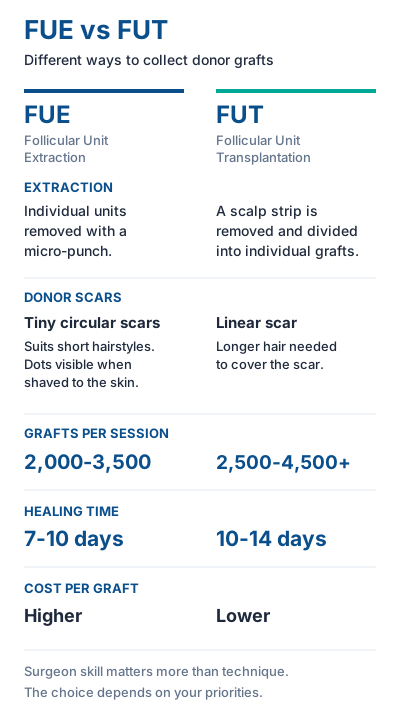
The Fundamental Difference
###FUT (Follicular Unit Transplantation / Strip Method)
How it works:
- A strip of scalp (typically 1cm x 15-25cm) is surgically removed from the donor area
- Strip dissected into individual follicular units under stereo-microscope
- Donor wound sutured closed (single-layer or multi-layer closure)
- Follicular units implanted into recipient area
Scar:
- Linear scar along donor area
- Width: 1-3mm with good technique
- Hidden by surrounding hair (minimum 2-3cm length covers it)
- Permanent but can be revised if wide
Pros:
- Highest graft yield per session (up to 4,500+ grafts)
- Faster extraction (1-2 hours vs 3-5 hours)
- Lowest cost per graft
- Less follicle transection (grafts intact when dissected)
- Can repeat 2-3 times if donor laxity allows
Cons:
- Linear scar (visible if shaved bald)
- Longer healing time (10-14 days)
- More post-op discomfort (tightness, numbness)
- Cannot wear very short hairstyles
FUE (Follicular Unit Extraction)
How it works:
- Individual follicular units punched out using micro-punch (0.6-1.0mm)
- Extraction dispersed across donor area (avoids visible depletion)
- Grafts stored in preservation solution
- Grafts implanted into recipient area
Scars:
- Tiny circular scars (0.6-1.0mm each)
- Hundreds or thousands scattered across donor area
- White dots, not visible with 2-3mm+ hair length
- Visible only if shaved to skin
Pros:
- No linear scar
- Can buzz head short (3mm+)
- Faster healing (7-10 days)
- Less post-op discomfort
- Can use body hair as donor source
Cons:
- More time-consuming (3-5 hours extraction)
- Higher cost per graft
- More follicle transection risk (if surgeon inexperienced)
- Limited to ~3,000-3,500 grafts per session
Detailed Comparison Table
| Factor | FUE | FUT |
|---|---|---|
| Extraction time | 3-5 hours | 1-2 hours |
| Grafts per session | 2,000-3,500 | 2,500-4,500+ |
| Donor scar | Tiny dots (0.6-1.0mm) | Linear (1-3mm wide) |
| Healing time | 7-10 days | 10-14 days |
| Post-op pain | Minimal (2-4/10) | Mild-moderate (3-5/10) |
| Return to exercise | 10-14 days | 14-21 days |
| Graft survival | 90-95% | 90-95% |
| Transection rate | 5-15% (skill-dependent) | 2-5% |
| Donor depletion risk | Moderate (if over-harvested) | Low (predictable) |
| Cost per graft (US) | $3.95-$7.99 (New York clinics that publish) | No published rate in our data |
| Can shave head | Yes (dots visible if skin-bald) | No (linear scar visible) |
| Body hair option | Yes | No |
| Repeat procedures | 2-3 possible | 2-3 possible |
Scarring: The Primary Decision Factor
For many patients, scarring is the deciding factor.
FUT Scarring Reality
Best case (experienced surgeon, good healing):
- Thin, fine line (1-2mm)
- Easily hidden with 2-3cm hair length
- Can be camouflaged with scalp micropigmentation if needed
Average case:
- Visible line (2-3mm)
- Hidden by surrounding hair when styled normally
- Noticeable if hair wet or windy
Worst case (inexperienced surgeon, poor healing, keloid-prone skin):
- Wide scar (5-10mm+)
- Stretched or raised
- Difficult to hide even with longer hair
- May require scar revision surgery
Can you see FUT scars?
- Not visible: 2-3cm+ hair length styled over donor area
- Slightly visible: Very short haircuts, hair pushed up
- Clearly visible: Buzz cut, completely bald
FUE Scarring Reality
Best case:
- Tiny white dots barely visible even when shaved
- Heal as small depressions in skin
- Can be camouflaged with scalp micropigmentation
Average case:
- White dot scars visible if completely bald
- Not noticeable with 2mm+ hair length
- Slightly visible in bright light if shaved to skin
Worst case (overharvesting, poor technique):
- "Moth-eaten" appearance in donor area
- Visible depletion even with hair present
- Permanent damage to donor zone
Can you see FUE scars?
- Not visible: 3mm+ hair length
- Slightly visible: 1mm buzz cut in bright light
- Clearly visible: Shaved to skin (tiny white dots)
The Shaved Head Question
"Can I shave my head after FUE?"
Yes, but with caveats:
- 1mm+ guard: Scars not noticeable in normal light
- Skin-bald with razor: White dot scars visible but not ugly
- Most men can pull off the buzzed look post-FUE
- Completely bald-shaved + bright light: Scars more apparent
"Can I shave my head after FUT?"
No, not to skin. Linear scar will be clearly visible. Minimum 2-3cm hair needed to cover.
If you might shave your head in the future, choose FUE.
Graft Yield and Efficiency
FUT Advantages
Higher yield per session:
- FUT can harvest 4,000-4,500 grafts in single session
- FUE typically maxes at 3,000-3,500 grafts
Why?
- Strip method accesses deeper follicles
- More controlled extraction environment
- Less trauma to individual grafts
Real-world impact:
Norwood 6-7 patients (extensive baldness) often need 4,500+ grafts for meaningful coverage. FUT can do this in one session; FUE requires two sessions 8-12 months apart.FUE Advantages
Donor area flexibility:
- Can extract from wider donor zone (sides, nape, even beard/chest)
- Useful if donor strip area has been depleted by previous FUT
- Better for patients with tight scalp (low donor laxity)
Body hair transplant (BHT):
- FUE can extract from chest, beard, legs (if scalp donor insufficient)
- FUT cannot use body hair
Pain and Recovery
Post-Operative Pain Levels
FUE:
- Pain level: 2-4/10
- Duration: 2-3 days
- Character: Mild soreness, tightness
- Medication: Over-the-counter pain relief usually sufficient
FUT:
- Pain level: 3-5/10
- Duration: 5-7 days
- Character: Tightness, tension, "pulled" feeling
- Medication: Prescription pain relief first 3-4 days, then OTC
Why is FUT more painful?
- Skin stretched and sutured (creates tension)
- Larger wound area
- Nerve endings severed (temporary numbness follows)
Healing Timeline
FUE:
- Days 1-3: Minimal discomfort, small scabs at extraction sites
- Days 4-7: Scabs shedding, donor area looking normal
- Day 10: Fully healed donor area, can resume exercise
- Week 2: Recipient area scabs gone
FUT:
- Days 1-3: Tightness, swelling, bandage over donor area
- Days 7-14: Sutures removed (or dissolve), linear wound still pink
- Days 10-14: Can return to work, donor area visible healing
- Weeks 3-4: Scar fading to pink line, can resume exercise
- Months 3-12: Scar continues to fade and flatten
Cost Comparison
Why is FUT cheaper per graft?
- Faster extraction: 1-2 hours vs 3-5 hours (time is money)
- Higher yield: More grafts per session = better economics
- Less equipment: No expensive micro-punches (used once and discarded)
- Older technique: More surgeons trained = competitive pricing
What clinics publish or patients report:
| Clinic | FUE | FUT |
|---|---|---|
| Thai Hair Clinic, Chiang Mai, Thailand (clinic-published, quoted in US dollars) | US$3.00 per graft, or $7,500 for 2,500 grafts | US$2.25 per graft for smaller sessions, US$1.89-2.20 for larger ones, or $4,730-$5,500 for 2,500 grafts |
| DHT Clinic, Bangkok (patient reports) | ฿123 per graft ($3.71) with Dr. Path, September 2025 | One patient reported ฿80 per graft ($2.41) with Dr. Moo and ฿120 ($3.62) with Dr. Path |
| New York clinics Maxim and Nova Medical (clinic-published) | $3.95-$7.99 per graft, or $9,880-$19,980 for 2,500 grafts | No published rate in our data |
The 2,500-graft totals are our arithmetic on the per-graft rates. Clinic prices read 21 to 23 September 2026. Dollars at ฿33.14 = $1 (European Central Bank reference rates, 22 September 2026).
Is FUT worth it for the savings?
Depends on:
- Can you accept a linear scar?
- Will you ever want to shave your head?
- Would saving about $2,000-$2,770 on 2,500 grafts (the gap at Thai Hair Clinic's published rates) matter to you?
If scar visibility is a dealbreaker, FUE is worth the premium.
Donor Area Management
FUT Donor Preservation
Advantage: Predictable and conservative
- Strip location planned carefully
- Doesn't deplete follicles outside strip zone
- Can repeat 2-3 times if scalp laxity allows
Concern: Scar widening
- Each subsequent FUT adds tension
- Scars can widen with multiple procedures
- Scalp laxity decreases over time
FUE Donor Preservation
Advantage: Flexibility
- Extract from large area (less visible depletion)
- Can target different zones in repeat procedures
Concern: Overharvesting risk
- Some surgeons extract too aggressively (depletes donor)
- "Moth-eaten" appearance if >50% of follicles removed
- Less reversible than FUT (no scar to revise, but depleted area permanent)
Conservative FUE practice:
- Extract max 25-30% of follicles from any area
- Rotate extraction zones in repeat procedures
- Leave "safety margin" for future needs
Transection Rates: Graft Damage
Transection = cutting a follicle during extraction (damages or destroys it)
FUT transection rates:
- Skilled surgeon: 2-5%
- Reason: Grafts dissected under microscope (high visibility, precision)
FUE transection rates:
- Skilled surgeon: 5-8%
- Inexperienced surgeon: 10-20%
- Reason: Blind punch into scalp (can cut follicles if angle wrong)
Real-world impact:
3,000-graft procedure:
- FUT at 3% transection: 2,910 viable grafts
- FUE at 7% transection: 2,790 viable grafts
- FUE at 15% transection: 2,550 viable grafts
Surgeon skill is critical for FUE. Check before/after results and ask about transection rates.
When to Choose FUT
Best for:
- Norwood 6-7 patients needing 4,000+ grafts
- Budget-conscious patients
- Those who will never shave head
- Patients with previous FUE overharvesting (FUT accesses deeper follicles)
- People with tight scalp (good laxity needed for strip closure)
Ideal candidate:
- Male, 35-55 years old
- Extensive baldness requiring maximum grafts
- Keeps hair 3cm+ length always
- Wants lowest cost per graft
- Values graft yield over scar type
When to Choose FUE
Best for:
- Norwood 2-4 patients (less extensive hair loss)
- Those wanting option to wear very short hair
- Patients with poor wound healing or keloid risk
- Active individuals (faster return to exercise)
- Those needing body hair transplant
- Repair work after failed previous transplant
Ideal candidate:
- Male or female, any age
- Moderate hair loss (2,000-3,000 grafts sufficient)
- Wants minimal downtime
- Willing to pay premium for no linear scar
- May shave head in future
The Combination Approach
Some patients use both:
- First procedure: FUT (maximize graft yield, lowest cost)
- Second procedure: FUE (extracts around FUT scar, adds density, avoids widening strip)
This strategy:
- Gets maximum grafts overall
- Uses FUE to camouflage FUT scar
- Balances cost and scarring concerns
Choosing Based on Hair Characteristics
Coarse, thick, curly hair:
- FUT works excellently (strip dissection preserves follicles well)
- Each graft provides maximum visual coverage
Fine, straight hair:
- FUE may be better (need every graft to survive; lower transection critical)
- DHI even better (highest survival rates)
Afro-textured hair:
- FUT preferred (curled follicles easier to transect with FUE punch)
- Specialized surgeons required for either technique
Making Your Decision
Answer these questions:
1. Will you ever shave your head?
- Yes or maybe: FUE
- Never: FUT is fine
2. How many grafts do you need?
- 4,000+: FUT
- 2,000-3,500: Either works
- Under 2,000: FUE
3. What's your budget?
- Limited: FUT
- Flexible: FUE
4. What's your pain tolerance?
- Low: FUE
- Normal: Either
5. How much time can you take off?
- 7-10 days: FUE
- 14+ days: Either
6. Do you have keloid tendency?
- Yes: FUE (consult dermatologist first)
- No: Either
Conclusion
FUE and FUT are not "better" or "worse." They're different tools for different situations. FUT excels at maximizing graft yield and minimizing cost, but leaves a linear scar. FUE offers scarless appearance and faster healing, but costs more and yields fewer grafts per session.
Our recommendation:
- Prioritize surgeon skill over technique (experienced surgeon using FUT beats inexperienced surgeon using FUE)
- If you might ever shave your head, choose FUE
- If you need 4,000+ grafts and budget matters, choose FUT
- If healing time and pain matter most, choose FUE
Next steps:
- Understand the third major technique: FUE vs DHI comparison
- Calculate your needs: How Many Grafts Do I Need?
- Return to the complete Hair Transplant Guide
Frequently Asked Questions
What is the difference between FUE and FUT hair transplants?
FUE (Follicular Unit Extraction) extracts individual follicular units using a micro-punch (0.6-1.0mm), leaving tiny circular scars scattered across the donor area. FUT (Follicular Unit Transplantation/Strip Method) removes a strip of scalp (1cm x 15-25cm) that's dissected into grafts, leaving a linear scar. FUE allows short hairstyles, has faster healing (7-10 days), minimal pain, but costs more and is limited to 2,000-3,500 grafts per session. FUT provides higher graft yield (up to 4,500+ grafts), lower cost, faster extraction, but leaves a linear scar visible if shaved bald and requires longer healing (10-14 days).
Which is better: FUE or FUT?
Neither is universally better - the best choice depends on your priorities. Choose FUE if you want to buzz your head short (3mm+), prefer no linear scar, want faster recovery, or need body hair as backup donor source. Choose FUT if you need maximum grafts in one session (4,000+ grafts for Norwood 5-6), want lower cost per graft, prefer faster surgery time, or always keep hair 2-3cm+ length to hide the linear scar. Both techniques achieve 90-95% graft survival with experienced surgeons - surgeon skill matters more than technique choice.
Can FUE scars be seen with a shaved head?
FUE leaves tiny white dot scars (0.6-1.0mm each) scattered across the donor area. These are not visible with 2-3mm+ hair length and can only be seen if shaved to the skin. With thousands of extraction points, donor area density reduces by 25-30% in extracted zones, which may be noticeable if you shave to skin level, especially on close inspection. However, FUE is still the preferred method for those who want the option to buzz very short. FUT's linear scar is more visible with short hair, requiring 2-3cm minimum length to hide.
How much does FUE cost compared to FUT?
At clinics that publish both, FUT costs less per graft. Thai Hair Clinic in Chiang Mai charges US$3.00 per graft for FUE and US$2.25 for smaller FUT sessions, falling to US$1.89-2.20 for larger ones: $7,500 versus $4,730-$5,500 for 2,500 grafts. One patient at DHT Clinic in Bangkok reported FUT quotes of ฿80 per graft with Dr. Moo and ฿120 with Dr. Path ($2.41 and $3.62). In the US, New York clinics publish $3.95-$7.99 per graft for FUE; we found no published US FUT rate. The difference reflects the longer surgery time (3-5 hours extraction vs 1-2 hours) and the more time-consuming individual extraction in FUE.