FUE vs DHI: Which Hair Transplant Technique Is Right for You?
Part of our comprehensive hair transplant guide, this comparison explains how FUE differs from DHI and which might be right for you. When researching hair transplants, you'll quickly encounter two acronyms: FUE and DHI. Clinics position them as different procedures, sometimes with significant price differences. In reality, DHI is a refinement of FUE. It's not a fundamentally different technique. Both extract individual follicles the same way, but they differ in how those follicles are implanted.
This guide breaks down exactly how FUE and DHI differ, when each technique excels, what the cost difference actually represents, and how to decide which is right for your specific situation.
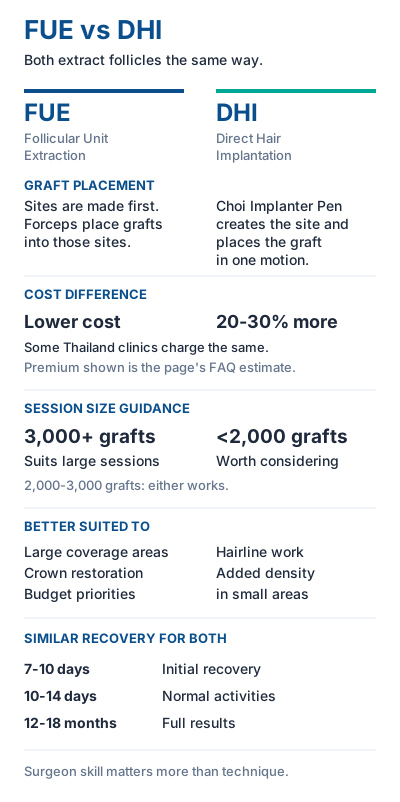
The Core Difference: Implantation Method
FUE (Follicular Unit Extraction)
Extraction: Individual follicular units removed with micro-punch (0.6-1.0mm)
Storage: Grafts stored in preservation solution (HypoThermosol or saline)
Implantation: Two-step process:
- Surgeon creates recipient sites with micro-blades or needles
- Technician (or surgeon) places grafts into sites using forceps
Time outside body: 2-6 hours from extraction to implantation
DHI (Direct Hair Implantation)
Extraction: Identical to FUE
Storage: Minimal (grafts loaded directly into Implanter Pen)
Implantation: Single-step process:
- Surgeon uses Choi Implanter Pen
- Pen creates site and deposits graft in one motion
- Immediate placement reduces ischemia time
Time outside body: 30 minutes to 2 hours
The critical advantage of DHI is reduced ischemia time, the period grafts spend without blood supply. Shorter ischemia typically means higher survival rates.
Side-by-Side Comparison
| Factor | FUE | DHI |
|---|---|---|
| Extraction method | Micro-punch (identical) | Micro-punch (identical) |
| Implantation tool | Forceps into pre-made sites | Choi Implanter Pen |
| Graft time outside body | 2-6 hours | 30 min-2 hours |
| Graft survival rate | 90-95% | 92-97% |
| Density achievable | 30-35 FU/cm² | 35-40+ FU/cm² |
| Procedure time | 4-6 hours | 5-9 hours |
| Shaving required | Donor area (can avoid with premium) | Can avoid on donor AND recipient |
| Learning curve | Moderate | Steep (Implanter Pen technique) |
| Price per graft (US) | $3.95-$7.99 (New York clinics Maxim and Nova Medical) | No separate rate in our data |
| Price per graft (Thailand) | ฿36-123 ($1.09-$3.71), what patients report across five Bangkok clinics | Same as FUE at HairTran and Hairsmith |
| Best for | Large sessions, budget priority | Hairline precision, maximum density |
How Each Technique Works in Detail
The FUE Process
Step 1: Donor area preparation
- Hair trimmed to 1-2mm (or kept long with "non-shaven FUE")
- Local anesthesia applied
Step 2: Extraction (2-4 hours)
- Surgeon uses motorized or manual punch tool
- Each punch extracts one follicular unit (1-4 hairs)
- Grafts immediately placed in preservation solution
- Extraction pattern: dispersed across donor area to avoid visible depletion
Step 3: Graft sorting and storage
- Grafts examined under microscope
- Sorted by hair count (single, double, triple, quadruple)
- Kept in HypoThermosol at 4°C (optimal for graft viability)
Step 4: Recipient site creation (30-60 min)
- Surgeon creates tiny incisions using:
- Angle, depth, and density pre-planned
- Sites stay open, waiting for grafts
Step 5: Implantation (2-4 hours)
- Grafts removed from storage one-by-one
- Placed into sites using fine forceps
- Requires steady hand and proper technique
- Single-hair grafts go to hairline, larger grafts to mid-scalp/crown
Total time: 4-8 hours depending on graft count
The DHI Process
Step 1-2: Identical to FUE
Donor preparation and extraction happen exactly the same way.Step 3: Direct loading
- Extracted grafts immediately loaded into Choi Implanter Pens
- Multiple pens used (loaded in rotation)
- No prolonged storage phase
Step 4: Implantation in single motion (3-5 hours)
- Surgeon holds Implanter Pen at precise angle
- Pen pushed against scalp: creates opening
- Trigger pressed: graft deposited at exact depth
- Pen withdrawn: site closes around graft
- Process repeated for each graft
Advantages of the Implanter Pen:
- Surgeon controls angle precisely (important for natural flow)
- Depth control built into device (consistent placement)
- Less handling trauma (graft never touched by forceps)
- Immediate placement (minimal ischemia)
Total time: 5-9 hours (slower due to precision, but better survival)
Graft Survival: Does DHI Actually Perform Better?
Short answer: Yes, marginally.
Clinical data:
- FUE: 90-95% graft survival (industry standard)
- DHI: 92-97% graft survival (ISHRS presentations, clinic data)
Why the difference?
- Reduced ischemia time: Grafts spend 1-4 hours less outside the body
- Less mechanical trauma: No forceps handling during placement
- Immediate blood supply: Graft placed directly into vascularized tissue
Real-world impact:
For a 2,500-graft procedure:
- FUE at 92% survival: 2,300 grafts survive
- DHI at 95% survival: 2,375 grafts survive
- Difference: 75 grafts
The difference is real but modest. Surgeon skill matters more than technique choice.
Scarring and Visibility
Both FUE and DHI:
- Leave tiny circular scars in donor area (0.6-1.0mm each)
- Scars are white dots, not visible unless you shave to skin
- Short hairstyles (3mm+) easily hide them
- Completely bald shave makes them noticeable (but faint)
FUT comparison:
- Linear scar (can be hidden by surrounding hair)
- More noticeable if you shave head completely
If you want the option to buzz your head, FUE or DHI are better choices than FUT.
Density and Natural Appearance
DHI advantages for hairline work:
The Implanter Pen allows:
- Precise angle matching (critical for frontal hairline)
- Variable depth control (single-hair grafts placed superficially)
- Tight packing without damaging surrounding tissue
- Exact follicle orientation (forward, not straight up)
Result: More natural-looking hairlines with sharper definition
FUE advantages for large area coverage:
Separate site creation and implantation allows:
- Faster overall procedure for 3,000+ grafts
- Easier team coordination (assistant can place grafts)
- Lower cost per graft (time is money)
Result: Better for covering extensive baldness on a budget
Recovery and Downtime
Both techniques:
- Same initial healing (7-10 days)
- Same swelling/scabbing timeline
- Same shock loss phase
- Same final growth timeline (12-18 months)
Minor DHI advantage:
- Slightly less bleeding (Implanter Pen causes less tissue disruption)
- Potentially less swelling (smaller openings)
- Minimal difference in practice
Both are outpatient procedures. You walk out the same day and return to work in 7-10 days.
Cost Analysis: Why Is DHI More Expensive?
Whether DHI costs more depends on the clinic. Where it does, these are the reasons.
Why?
- Specialized training: Implanter Pen technique requires certification
- Longer procedure time: 5-9 hours vs 4-6 hours for FUE
- Equipment cost: Choi Pens are single-use and expensive
- Surgeon-dependent: DHI can't be delegated to technicians (entire implantation must be surgeon-performed)
Exception: Thailand and some Asian clinics
HairTran and Hairsmith in Bangkok include the implanter pen at their FUE price. Only CosmoPrime lists a DHI rate, ฿60-90 per graft, in a general price table on its own site.
Price examples (2,500 grafts):
| Location | FUE Cost | DHI Cost |
|---|---|---|
| USA | $9,880-$19,980 at the $3.95-$7.99 per graft New York clinics publish (our arithmetic) | No separate rate in our data |
| UK | £6,900 (Westminster Medical Group, London) | No separate rate in our data |
| Turkey | Packages of €2,390-€8,000 that include hotel and transfers (Smile Hair Clinic, Cosmedica, Hermest) | Cosmedica's range includes its DHI packages |
| Thailand | ฿90,000-307,500 ($2,720-$9,280), from what patients report across five Bangkok clinics (our arithmetic) | Same as FUE at HairTran and Hairsmith. DHI Thailand publishes about ฿100,000-200,000 ($3,020-$6,040) for 2,000-4,000 grafts |
Clinic prices read 21 to 23 September 2026; Thai figures are what patients reported paying, 2023 to 2025. Prices a clinic quotes in its own currency are shown in that currency. Dollars at ฿33.14 = $1 (European Central Bank reference rates, 22 September 2026).
When to Choose FUE
Best for:
- Large sessions (3,000+ grafts in one day)
- Budget-conscious patients
- Crown restoration (where exact angle matters less)
- Patients with coarse, thick hair (visual coverage is good even with 30-35 FU/cm² density)
Scenarios where FUE excels:
- Norwood 5-7 patients needing extensive coverage
- Body hair transplant (BHT): Implanter Pen doesn't work well with body hair
- Corrective procedures (fixing previous bad transplants)
Advantages:
- Lower cost per graft
- Faster procedure (less time under local anesthesia)
- Proven track record (decades of FUE data)
- More surgeons skilled in technique
When to Choose DHI
Best for:
- Hairline refinement
- Patients wanting maximum density
- Those with fine hair (need every graft to survive)
- People who can't shave head (non-shaven DHI easier to perform)
Scenarios where DHI excels:
- Norwood 2-4 patients (hairline recession, not extensive baldness)
- Women with traction alopecia (hairline repair)
- Patients with previous transplant seeking added density
- Anyone prioritizing absolute best survival rates
Advantages:
- Higher graft survival (92-97% vs 90-95%)
- More precise angle control
- Less handling trauma
- Can achieve 35-40+ FU/cm² density
Surgeon Skill: The Variable That Matters Most
Key insight: A highly skilled surgeon doing FUE will get better results than an inexperienced surgeon doing DHI.
What matters more than technique:
- Surgeon credentials: ABHRS or ISHRS certification
- Experience: 500+ procedures minimum
- Graft handling: Proper extraction without transaction (cutting follicles)
- Artistic eye: Natural hairline design for your face
- Conservative planning: Not overharvesting donor area
Red flags:
- Technicians performing implantation (common in Turkey's high-volume clinics)
- Surgeon claims "100% survival rate" (biologically impossible)
- Clinic pushes DHI aggressively without explaining why
- No option to see surgeon's own work (just stock photos)
The Hybrid Approach: Best of Both
Some surgeons use a hybrid:
- DHI for hairline (first 1-2cm where angle is critical)
- FUE for mid-scalp and crown (faster, still effective)
This balances:
- Natural-looking frontal result
- Faster overall procedure
- Lower cost than full DHI
Ask your surgeon if they offer this approach.
Non-Shaven Options: FUE vs DHI
Both techniques can be performed without shaving, but DHI handles it better.
Non-shaven FUE:
- Extracting long hairs is difficult (more transection risk)
- Implanting long grafts requires extreme care
- Costs more: Hairsmith in Bangkok publishes ฿120 per graft for non-shaven FUE against ฿80 for standard FUE
- 7-9 hours procedure time
Non-shaven DHI:
- Implanter Pen naturally handles long grafts better
- Easier to control depth with existing hair present
- Still expensive but more reliable results
Who needs non-shaven:
- Professionals who can't hide shaved head
- Women (shaving entire head often not acceptable socially)
- Those wanting immediate visible result (long transplanted hairs)
Tradeoff: Lower graft survival (85-92% typical) due to increased handling difficulty.
Making Your Decision: A Decision Tree
Answer these questions:
1. What's your primary concern?
- Budget: FUE
- Maximum density: DHI
- Natural hairline: DHI
- Large area coverage: FUE
2. How much are you transplanting?
- Under 2,000 grafts: DHI worth considering
- 2,000-3,000 grafts: Either works
- Over 3,000 grafts: FUE more practical
3. What's your hair type?
- Fine, thin hair: DHI (need every graft)
- Coarse, thick hair: FUE fine (each graft covers more)
4. Can you shave your head?
- Yes: Either technique
- No: DHI handles non-shaven better
5. What's your location?
- Anywhere: ask whether DHI is priced separately
- HairTran or Hairsmith in Bangkok: same price as FUE (choose DHI)
Conclusion
FUE and DHI are not radically different techniques. They extract hair identically and differ only in implantation method. DHI offers marginally better graft survival (2-5% higher) and more precise angle control, making it ideal for hairline work and maximum density. FUE remains the practical choice for large sessions and budget-conscious patients.
The truth: Surgeon skill matters far more than FUE vs DHI. A skilled surgeon using FUE will beat a mediocre surgeon using DHI every time.
Our recommendation:
- Choose your surgeon first (credentials, experience, reviews)
- Ask which technique they recommend for YOUR case
- If they offer both at similar price (like some Thailand clinics), choose DHI
- If DHI costs 30%+ more, FUE is usually the smarter choice unless hairline precision is your top priority
Next steps:
- Read our detailed FUE vs FUT comparison to understand the third major technique
- Return to the complete Hair Transplant Guide for all topics
- Calculate your needs with our How Many Grafts Do I Need guide
Frequently Asked Questions
What is the difference between FUE and DHI hair transplants?
The core difference is the implantation method. FUE (Follicular Unit Extraction) extracts follicles then creates recipient channels before implanting grafts in two steps. DHI (Direct Hair Implantation) uses a Choi Implanter Pen to create the channel and implant the graft simultaneously in one step, giving surgeons more control over angle and depth.
Is DHI better than FUE for hair transplants?
Neither is universally better. DHI offers higher density placement and less handling of grafts (potentially better survival rates), but takes longer. Pricing varies: some clinics, such as HairTran and Hairsmith in Bangkok, include the DHI pen at their FUE price. FUE is better for large sessions (3,000+ grafts) and is more widely available. Choose DHI for hairline work and density in small areas. Choose FUE for large coverage areas and crown restoration.
Why is DHI more expensive than FUE?
Where DHI costs more, it is because it requires specialized Choi Implanter Pens, additional training for surgeons, slower procedure time (each graft individually loaded and placed), and a larger surgical team. In Bangkok, only CosmoPrime lists a DHI rate, ฿60-90 per graft in a general price table on its own site, and HairTran and Hairsmith include the pen at their FUE price. DHI Thailand, a DHI-only clinic in Bangkok, publishes about ฿50,000-100,000 ($1,510-$3,020) for 1,000-2,000 grafts and ฿100,000-200,000 ($3,020-$6,040) for 2,000-4,000 grafts.
What is the recovery difference between FUE and DHI?
Recovery is similar for both. DHI may have slightly faster healing in the recipient area since channels are created and filled simultaneously, causing less tissue trauma. Both techniques require 7-10 days of initial recovery and 10-14 days before returning to normal activities. Full results take 12-18 months for both.