Best Age for a Hair Transplant: Timing Your Procedure
Part of our comprehensive hair transplant guide, this page explains how age relates to hair transplant timing. Hair transplants can be performed at almost any age as long as you are healthy. This guide covers what the ISHRS says about young and older patients and the factors that matter more than a specific number.
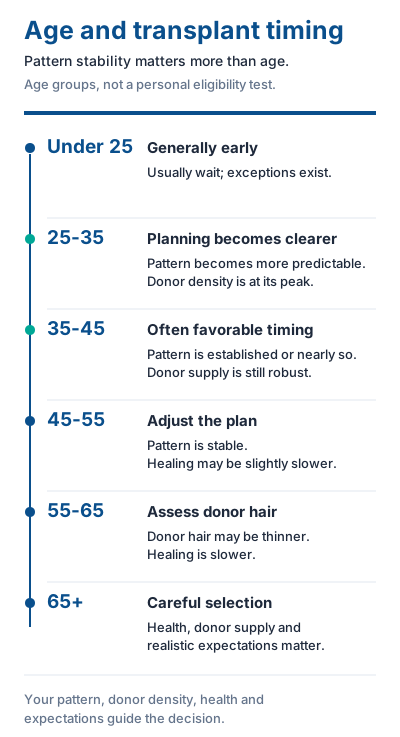
The Age Spectrum
Under 21: Why Many Surgeons Advise Waiting
ISHRS census: In the 2025 ISHRS Practice Census, 73.0% of the 178 members who answered said they have a cut-off age for surgery on a young patient. The average minimum was 22 (median 23, range 17 to 30).
The ISHRS says most leading hair restoration physicians do not consider hair transplantation a good option for most men under age 21, and that it may rarely be an option for an individual young man when his own characteristics call for it.
Why waiting matters:
1. Pattern not fully developed
- The ISHRS says it is extremely difficult to determine the pattern of hair loss at such a young age due to the progression of the condition. (see male pattern baldness figures)
- Often needs further surgeries to keep a natural look
2. Hormonal changes
- Donor hair follicles can still be affected by DHT and continue to fall after the transplant
- Hair loss can be unpredictable in your 20s (ISHRS)
3. Psychological factors
- Need a plan for ongoing hair-loss management with a clinician
What the ISHRS says about waiting:
- A physician can reassess after 12 months of treatment (ISHRS)
Early 20s and After: When Patients Have a First Procedure
The ISHRS patient brochure says patients may have hair restoration surgery at any age after the early 20s, and that the decision depends on the individual patient. In the ISHRS 2025 Practice Census, members were asked the average age of their first-time surgery patients. Of the 177 who answered, 57.6% said 26 to 35 and 37.3% said 20 to 25. That shows when patients usually have a first procedure. It does not show which age gives the best result.
Age 50 and Older
The ISHRS says any age can be the right age for a hair transplant as long as you are healthy and do not have any complex diseases. It also says excellent results are common in men aged 70 and older who decide to have a transplant late in life. A surgeon should check your health, your donor area and the area you want covered before planning surgery.
Best Age for a Hair Transplant for Women
For women, start with the cause of thinning and whether enough healthy donor hair remains. The American Academy of Dermatology (AAD) says a hair transplant may be an option for some women with female pattern hair loss.
The AAD says this condition usually begins in midlife, though it can start earlier. It is progressive, meaning women tend to keep losing hair. Ask your doctor whether the thinning is still changing and how that affects the proposed timing.
If hair is sparse across the scalp, the AAD says there may not be enough healthy hair to transplant. Ask the surgeon to examine the area they would take hair from and explain whether it can supply the areas you want treated.
If shedding began after childbirth, ask for an assessment before planning hair transplantation. The AAD says hair may regrow on its own in this situation. Your doctor can advise whether to allow time for regrowth, discuss treatment, or assess you for surgery.
Factors That Matter More Than Age
Hair Loss Stability
How to assess stability:
- Reassess with a physician after 12 months of treatment (ISHRS)
- Track with Norwood scale
- Monitor with dermatologist
Donor Hair Density
Density more critical than age:
Plenty of donor hair:
- Ample supply for comprehensive result
Low density:
- May not be candidate even if young
- Limited grafts available
- Requires conservative approach
Testing donor density:
- Critical for estimating total grafts available
Overall Health Status
Health trumps age:
The ISHRS says most medical conditions pose little risk if the conditions are recognized and appropriate precautions are taken. It lists heart disease, high blood pressure, diabetes and bleeding disorders as conditions that may indicate the need for precautions. It says warfarin (Coumadin) and aspirin, which reduce the ability of blood to form clots, may also call for precautions.
Tell the hair restoration specialist about every medical condition and every medication you take or have recently taken. Do not stop a prescribed blood thinner without talking to the doctor who prescribed it.
Planning Maintenance
Review long-term management of native hair with your clinician. Discuss finasteride's potential benefits, risks and alternatives, and how ongoing hair loss affects surgery planning.
Age-Specific Design Considerations
Mature Hairline
- A mature hairline usually sits about 1-1.5 cm above the highest forehead wrinkle, where the juvenile hairline was, according to Donovan Medical
Key: Match your hairline to your age, not to teenage photos
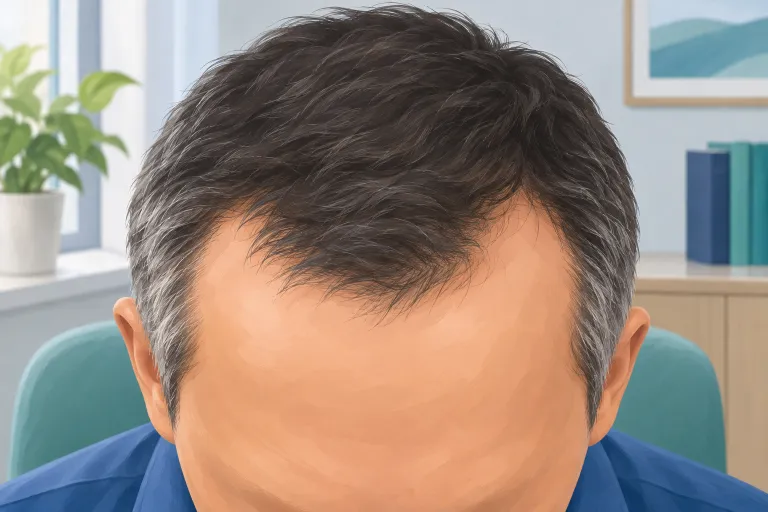
Older Patients and Expectations
The ISHRS says the man aged 55 or older will rarely expect to reverse the effects of decades of hair loss, and that restoration which relieves the cosmetic impairment of baldness is usually considered very satisfactory. For an older man with minimal hair loss who wants results comparable to a younger man's, it says whether that is achievable should be discussed with the specialist after the scalp examination. It lists the degree of hair loss, the amount and quality of donor hair, and anticipated future hair loss as the points to discuss.
The Role of Finasteride
The manufacturer's US prescribing information describes its indication for male pattern hair loss in men (read 29 October 2026).
Discuss whether finasteride fits your circumstances with your prescribing clinician. Follow the plan they prescribe, including future reviews.
What to Do While Waiting for a Hair Transplant
If you're advised to wait for a hair transplant, ask your doctor for a diagnosis and a review plan now. Agree on what needs to change before surgery becomes an option.
Find out what is causing the hair loss
The American Academy of Dermatology (AAD) describes a scalp examination and questions about when the loss began as part of diagnosis. Bring a timeline of the changes you've noticed.
The AAD says blood tests or a scalp biopsy may be needed if the doctor suspects a disease, deficiency, hormone problem or infection. Ask which tests your examination points to and how the results would affect treatment.
Agree on how treatment will be reviewed
Ask whether topical minoxidil, a treatment applied to the scalp, is appropriate for you. In its male pattern hair loss guidance, the AAD says some men see no difference. If it works, results can take up to six to 12 months.
Let your doctor choose any treatment and its review schedule. Ask what improvement they will assess, what side effects to report, and when to revisit transplant surgery if treatment doesn't help.
For minors, the International Society of Hair Restoration Surgery (ISHRS) says a parent or guardian must take part in decisions. It also says minors shouldn't be pressured into hair restoration treatment.
Before booking surgery travel to Thailand, request the doctor's reasons for recommending surgery now or waiting. Keep the review plan in writing, including who you will contact from home.
Making the Decision at Your Age
Ask yourself:
If under 30:
- Has my hair loss been stable for 12-24 months, as an Acibadem International blog post says most surgeons want?
- Have I discussed finasteride and alternatives with a prescribing clinician?
- Can I accept a mature (not teenage) hairline?
- Have I consulted with 2-3 surgeons who agree I'm ready?
If 30-50:
- Is my pattern predictable now?
- Do I have adequate donor supply?
- Are my expectations realistic?
- Can I afford a quality surgeon?
If 50+:
- Am I healthy enough for surgery?
- Will I be satisfied with age-appropriate improvement?
- Is my donor hair adequate?
Conclusion
There is no single best age for a hair transplant. The ISHRS says any age can be the right age as long as you are healthy. Individual factors (pattern stability, donor density, health, expectations) matter more than a specific age number.
The ISHRS says most leading hair restoration physicians do not consider a transplant a good option for most men under 21. After that, it says any age can be the right age if you are healthy.
The key: Match timing to pattern stability, not just age.
Next steps:
- Assess if it's worth it for you: Is a Hair Transplant Worth It?
- Return to complete guide: Hair Transplant Guide
Read next
- Hair transplant for womenDonor assessment, FUE and FUT, no-shave options, medication, recovery and cost questions for women with thinning hair.
- Is a hair transplant permanent?What long-term studies and patients report about donor hair, ongoing thinning, medication and second procedures.
- Hair transplant success rateGraft survival, what time outside the body does to grafts, what affects survival and what a realistic outcome looks like.
- Is a hair transplant worth it?Cost, success rates, psychological impact and the alternatives, weighed honestly so you decide on facts.