Facelift scars: incision placement, healing and what affects visibility
Facelift scars from a traditional facelift often follow surgical cuts, called incisions, from the temple hairline around the ear and into the lower scalp. An under-chin incision may be added for an aging neck, according to the American Society of Plastic Surgeons (ASPS). The UK National Health Service (NHS) says scars should fade but won't completely disappear.
If you're considering facelift surgery in Thailand, ask the surgeon about scar placement and follow-up before choosing the operation. Choosing an operation needs a discussion with your surgeon.
Clinics cannot pay to be listed or ranked higher on AsiaPatient.
Where facelift incisions may sit
The British Association of Aesthetic Plastic Surgeons (BAAPS) describes a line above the temple hairline, down the front of or just inside the ear cartilage. It continues around the earlobe, up the crease behind the ear and into the lower scalp.
Ask which parts of the BAAPS description and ASPS incision patterns apply to your proposed facelift surgery.
| Area on the incision map | Source description | What to ask the surgeon |
|---|---|---|
| Temple hairline | ASPS: often starts in the hairline | Where will my incision start? |
| Front of the ear | BAAPS: in front or just inside the cartilage | Which line do you propose here? |
| Earlobe | BAAPS: continues around behind it | Can you mark this part for me? |
| Crease behind the ear | BAAPS: continues up this crease | How far will it extend? |
| Lower scalp | Both describe the line continuing here | Will it extend into hair-bearing scalp? |
| Under the chin | ASPS: an extra incision may be necessary | Is it planned, and what would it address? |
Temple, ear, earlobe, postauricular crease, and lower scalp
The postauricular crease means the crease behind the ear. In the BAAPS facelift description, it forms part of the route between the earlobe and lower scalp.
Ask the surgeon to draw the full proposed line on a photograph or diagram. Include the part behind the ear, even if your main concern is the scar in front of it.
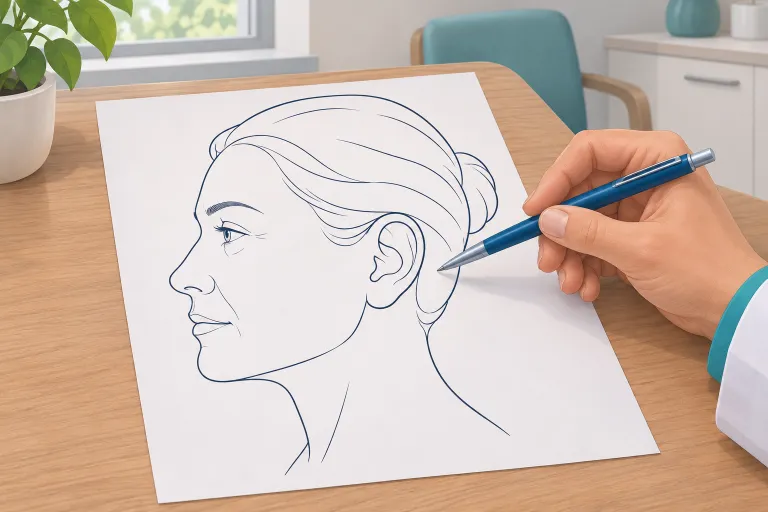
Bring that marked plan back to the consultation if any location is unclear. Ask where each incision begins and ends, rather than accepting only the phrase "around the ear."
When an under-chin incision may be added
An under-chin incision may be needed. ASPS describes it as an additional incision to further improve an aging neck.
Ask whether your proposed facelift includes neck work and whether that work adds an incision. Have the surgeon identify its purpose on your plan, separately from the temple and ear incisions.
For the broader procedure names, see facelift types. Keep your own incision map beside the proposed operation name.
Will facelift scars show?
The NHS says facelift scars should fade but won't completely disappear. Use that expectation when discussing how much a scar might show.
Natural ear contours and hairline placement
ASPS describes healed incision lines as well concealed within the hairline and natural contours of the face and ear. Ask the surgeon to show which parts of your proposed line would sit in those locations.
Discuss the view from the side as well as the front. Ask to see the full line with your hair moved away, then with your usual hairstyle.
Facelift scars behind the ears
BAAPS places part of the facelift incision in the crease behind the ear before it extends into the lower scalp. Ask how visible those parts could be with your hair up or cut short.
Point out which everyday views concern you. For example, ask the surgeon to explain the expected visibility when someone sees you from behind with your hair tied back.
Practical concealment and its limits
In its facelift guidance, BAAPS describes hair and disc-shaped earrings as ways women can conceal scars. It says camouflage makeup can help mask bruising and notes that men find scars harder to disguise.
Ask how that advice applies to your haircut and whether earrings are something you normally wear. If you use makeup, ask the surgeon when and where you can apply it after your operation.
Tell the surgeon if you don't want to change your hairstyle to cover an incision. Ask them to discuss visibility with that preference in mind, including any part that would remain exposed.
Scars fade but do not completely disappear
Keep the NHS's statement that scars don't completely disappear in mind when discussing expectations. Ask what the surgeon means if they describe a scar as "hidden."
Does that description assume hair covers it, or refer to its position within natural creases? Ask how the surgeon would discuss a scar that remains more noticeable than you expected.
Why scar patterns differ by facelift plan
Ask for the incision plan even when you've already discussed a technique by name. The location questions remain relevant when you compare the operations proposed at consultation.
Traditional versus limited incisions
ASPS describes shorter temple incisions continuing around the ear as an alternative to the traditional pattern. It says mini-lifts are usually reserved for patients with less skin relaxation.
For a proposed mini facelift, ask which parts of the traditional incision route are shortened or omitted. Ask the surgeon to explain how the planned length relates to the areas you want to discuss.
If you're discussing a deep plane facelift, request the same drawing of the skin incisions. Ask what supports any claim that the proposed technique would produce less visible scars in your case.
A neck component changes the discussion
An ASPS article on neck lifting says facelifts and neck lifts are often combined. It quotes a surgeon saying the same incision may be used for both procedures.
For a combined plan, ask which incision serves each part of the operation. Ask whether any additional cut is proposed, including under the chin, and have it added to the drawing.
Scar-related risks to discuss before surgery
Use the consent discussion to ask about scars and wound healing specifically. Ask the surgeon to explain what a concern would mean for your care and who would assess it.
Thick or obvious scars, hair loss, and healing problems
The NHS lists thick, obvious scars and healing problems among possible facelift complications. It also lists hair loss or a small but permanent reduction in hair growth around scars.
Ask how the surgeon assesses these risks for you. If you've had a scar that concerned you before, ask whether they want to examine it or see a photograph.
Infection and questions about wound healing
The NHS includes infection among the small risks carried by any operation. It says the surgeon should explain the likelihood of risks and how they would be treated.
Ask which incision changes should prompt a call and which need an examination. Request written contact instructions, including where to get help if the operating team can't assess you promptly.
Factors the surgeon needs to assess
Yanhee International Hospital's facelift page says smoking "raises the risk of complications and worsens scarring." Tell the surgeon if you smoke and ask which preparation instructions apply to you.
Ask whether your health conditions, medicines or previous healing experience change the proposed plan. Have the surgeon explain any preparation needed before deciding whether to proceed.
Thailand follow-up questions before booking
Request a written incision plan and follow-up schedule for the exact operation being offered. Include the appointments in Thailand and the arrangements for concerns after you return home.
Confirm the exact facelift name, incision plan, and local follow-up
Yanhee's public facelift page describes an incision that "usually starts above the hairline at the temples" and continues in front of the ear, behind the earlobe and into the lower scalp. Ask your operating surgeon to confirm the line proposed for you.
Take these questions to the consultation:
Request a copy of the marked incision plan. Ask for any changes discussed at consultation to be reflected in the written version before surgery.
Don't infer follow-up from a headline price
Ask the hospital to list the follow-up appointments included in your booking. Request separate answers about incision care and review after you leave Thailand.
For general recovery information, see facelift recovery. Ask your surgeon to give you the appointment schedule and care instructions for your own incisions.
Related procedures: neck lift scars.
Frequently asked questions
Where are facelift scars usually placed?
ASPS describes a traditional incision from the temple hairline around the ear into the lower scalp. BAAPS adds the detail of the earlobe and crease behind the ear.
Does every facelift need an incision under the chin?
No. ASPS says an additional under-chin incision may be necessary for an aging neck. Ask whether it's included in your proposed operation.
Are facelift scars behind the ears visible?
Ask the surgeon to assess visibility using your proposed incision line and hairstyle. BAAPS describes placement in the crease behind the ear and lower scalp; have the surgeon show you both parts.
Can men hide facelift scars as easily?
BAAPS says men find scars harder to disguise. Ask what concealment would involve with your own haircut and grooming preferences.
Do facelift scars disappear completely?
No. The NHS says they should fade but won't completely disappear.
How does facelift scar healing work?
The NHS says scars should fade but will not completely disappear. Ask your surgeon what changes to expect in your incisions and when they plan to review them.
Can short hair or a ponytail make facelift scars more noticeable?
Ask the surgeon to assess both hairstyles against the marked incision plan. BAAPS discusses hair as a way to cover scars; ask which parts would be exposed with your hair short or tied back.
What scar and follow-up questions should I ask a Thailand surgeon?
Ask for every incision location, including any under-chin cut, and the written wound-care instructions. Confirm who reviews the incisions locally, which appointments are included, and who will assess a concern after you return home.
Read next
- Deep plane facelift vs SMAS and mini faceliftHow the deep plane facelift differs from SMAS and mini facelifts, what studies report on each, and what Thai hospitals print about the techniques.
- Mini facelift: who it suits and what it costs in ThailandWhat a mini facelift treats, how it differs from a full facelift, recovery, its limits and what Thai hospitals and clinics print for the price.
- SMAS facelift, and how it differs from a deep plane faceliftWhat an SMAS facelift changes, how it differs from a deep plane facelift, recovery, risks and questions to ask in Thailand.
- Fat transfer to the face, with a facelift or on its ownHow facial fat transfer works, when it may be combined with a facelift, recovery, absorption uncertainty and questions for Thai hospitals and clinics.
Ask the Surgeon Where Your Facelift Incisions Will Sit
Tell us the procedure, your budget and your dates, and any hospitals you are considering.
Get My Free Quote →Free, no obligation. Nothing goes to a clinic without your OK.