SMAS Facelift Thailand: How It Compares With Deep Plane, Recovery and Risks
A SMAS facelift works on the superficial musculoaponeurotic system (SMAS), a tissue layer below facial skin in the midface and lower face, according to the American Society of Plastic Surgeons (ASPS). Cleveland Clinic describes a deep plane facelift as lifting the SMAS, fat and skin as a single unit.
Clinics cannot pay to be listed or ranked higher on AsiaPatient.
What the SMAS layer is, and what a SMAS facelift changes
Cleveland Clinic calls the SMAS the muscular layer of the face. It describes SMAS surgery as targeting the lower two-thirds of the face, tightening muscle and trimming excess skin or fat in the cheeks and lower face.
For the broader treatment and travel decision, see facelift in Thailand. For a consultation about SMAS, ask the surgeon to identify the tissue they plan to move and the areas that concern you.
The American Academy of Facial Plastic and Reconstructive Surgery (AAFPRS) says a facelift can't stop aging, correct skin texture or discoloration, change bone structure, or lift brows and eyelids. Ask which of your concerns the proposed facial surgery would address and which would need a separate discussion.
SMAS versus deep plane facelift
AAFPRS describes SMAS surgery as lifting and tightening the layer below the skin. Its deep-plane description involves repositioning muscle and fat beneath the SMAS, with more extensive elevation and release of deeper attachments.
The categories can overlap, according to AAFPRS. Ask the surgeon to explain the actual steps in your proposed surgical approach.
In one 2025 systematic review and meta-analysis, Vayalapra and colleagues assessed 47 studies involving 10,766 patients. It reports improved aesthetic outcomes with both technique groups, but its abstract doesn't identify the patients' countries.
Only one included study directly compared them, favoring deep techniques for midface rejuvenation. The review authors say limited direct comparisons and differing outcome measures prevent firm conclusions about relative effectiveness.
See deep plane facelift in Thailand for more on deeper attachments and surgical scope.
Tissue layers and intended areas of change
Cleveland Clinic describes SMAS work that targets the cheeks and lower face. Its deep-plane description lifts the muscle layer, fat and skin as one unit.
In an ASPS surgeon interview, Dr. Hussain describes deep-plane surgery as releasing all three retaining ligaments. That is his description of the technique; AAFPRS uses the broader wording of deeper-attachment release.
Ask the surgeon to mark the planned cheek, jawline and neck work separately. Which areas would each proposed approach change, and why?
The SMAS approaches surgeons describe
The ASPS anatomy article lists several ways of treating deeper facial tissue:
- SMAS plication
- Cranial suspension with looped sutures
- SMAS excision, also called SMASectomy
- Elevation of a SMAS flap
AAFPRS describes extended SMAS as making an incision in that layer, lifting it and repositioning it. Ask whether your plan involves suturing, removing or lifting SMAS tissue, and what the surgeon means by the technique's name.
Subcutaneous facelifts and the SMAS
The ASPS article says a subcutaneous facelift doesn't directly treat the underlying soft tissues and relies on skin tension to reposition them.
The same ASPS source says excessive skin tension increases the risk of wound-healing problems, abnormal scarring, facial flattening and early recurrence. Ask how the proposed operation supports the deeper tissues and closes the skin.
Incisions, anesthesia and surgical scope
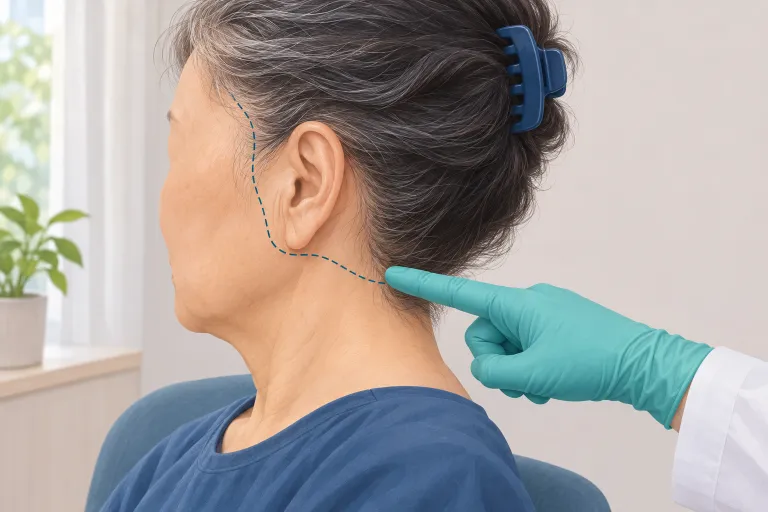
The UK National Health Service (NHS) describes cuts starting above the hairline at the temples and continuing in front of, beneath and behind the ear. It also describes an under-chin incision when the jawline is being lifted.
An ASPS surgeon-authored article describes an incision extending from the temple hairline to the lower scalp. The NHS says scars should fade but won't disappear completely.
For anesthesia, AAFPRS describes local anesthesia with sedatives and mild intravenous anesthesia, or general anesthesia. The ASPS anatomy article also lists general anesthesia or intravenous sedation.
Ask for your incision map and anesthesia plan. Will the operation include neck surgery, and would that change the incisions or hospital stay?
SMAS facelift recovery and aftercare
AAFPRS says facelift recovery usually takes two to three weeks. The NHS gives about two to four weeks for full recovery and says to take that time off work.
These are general facelift timelines. An ASPS recovery article emphasizes following your surgeon's instructions, because individual recovery varies.
See facelift recovery in Thailand for more on local follow-up and recovery planning.
Recovery milestones
| Milestone | Source-specific timing |
|---|---|
| Dressings and drains | AAFPRS says dressings may come off in 1 to 2 days; drains, if used, generally come out in 1 to 2 days. |
| Stitches and staples | AAFPRS says sutures and staples are usually removed within five to 10 days, and that some sutures dissolve on their own. The NHS gives about 7 to 14 days for stitches, unless they dissolve. |
| Returning to work | AAFPRS says many patients feel comfortable returning in two weeks. Cleveland Clinic gives two to three weeks for more invasive facelifts. |
| Activity restrictions | The NHS advises avoiding strenuous activity, saunas and massage for at least two weeks. |
| Feeling normal | Cleveland Clinic says the face can take two to three months to feel back to normal. |
| Seeing the final effect | The NHS says you should be able to see final results after six to nine months. |
Aftercare instructions to confirm before travel
The NHS advises keeping the head raised on pillows while resting for a couple of days. It also says to keep bandages dry for the first two days.

The ASPS anatomy article links active smoking with increased wound-healing complications. Ask for smoking and medication instructions that account for your medical history.
SMAS facelift risks and study findings
AAFPRS lists infection, unfavorable scars, hematoma or seroma, temporary or permanent nerve damage, anesthesia reactions, asymmetry and hair loss near incisions.
ASPS also lists bleeding, poor wound healing, skin loss, numbness or other sensory changes, persistent pain and prolonged swelling. Its list includes blood clots in deep veins and heart or lung complications.
The Vayalapra review reported pooled hematoma rates of 2% for SMAS and 3% for deep-technique facelifts. The authors described similar nerve-injury rates between groups, with most reported injuries temporary and permanent injury rare.
One systematic review by Mortada and colleagues, published in 2023, examined six SMAS techniques across 27 studies involving 6,086 patients. Patient countries are unspecified in its abstract.
That review reported temporary facial-nerve injury in 0.85% and skin necrosis in 0.41%. Complication rates varied by technique, and the authors said incomplete reporting made identifying the best approach difficult.
Ask the surgeon for an assessment of your own risks and how complications would be treated. What care would be arranged if a problem arose after you returned home?
Planning a SMAS facelift in Thailand
YOUNIFY Clinic says most patients plan approximately 10 to 14 days in Bangkok from the day of surgery, with a first review before flying. Ask your surgeon when you could fly and which appointments need to happen first.
For the financial part of planning, see facelift cost in Thailand. Request a written quote that identifies the SMAS approach, treatment areas and aftercare included.
What Thai hospitals and clinics print about consultation and follow-up
YOUNIFY describes its SMAS plication as follows: "The SMAS layer is sutured back into position without extensive deep dissection." This is the clinic's description of that approach.
Its general-anesthesia inclusions cover a consultation, preoperative tests, a board-certified surgeon and anesthesiologist, one hospital night, medication, dressings and a follow-up visit. As of 4 November 2026, these are YOUNIFY's stated package terms.
YOUNIFY's travel section says: "First review in Bangkok before you fly." It also offers follow-up through WhatsApp after patients return home.
Kamol Hospital lists a full facelift with SMAS and describes a separate SMAS flap and SMASectomy. Its aftercare text says: "Sutures are removed around 5-10 days after surgery".
Bangkok Hospital Headquarter's fly-in package is labeled "Face & Neck Lift" and lists one hospital night. Its fly-in offer expires on 31 December 2026; ask which technique the surgeon proposes within that package.
The hospital's terms list operating and recovery rooms, supplies, operation-specific medicine, and surgical and anesthesia teams in a sentence ending "only". A separate inclusion line adds a standard inpatient room, nursing, package food and medical equipment.
The package exclusions include medical clearance, specialist consultation, complication treatment, laboratory investigations and take-home medication. Its clearance statement says: "This is an additional cost."
The hospital's separate SURGERY MASTER promotion offers free medical clearance for qualifying fly-in operations, subject to a minimum spend and at least one hospital night. As of 4 November 2026, the clearance terms differ. Ask the hospital which applies to your booking.
Questions to take to a consultation
In this section: facelift in Thailand, facelift in Bangkok, what a facelift costs in Thailand, deep plane facelift, fat transfer facelift, how long it lasts facelift, mini facelift and facelift recovery.
Frequently asked questions
What is a SMAS facelift?
A SMAS facelift lifts and tightens the facial tissue layer below the skin, according to AAFPRS. SMAS stands for superficial musculoaponeurotic system.
Is a SMAS facelift better than a deep plane facelift?
The Vayalapra review calls for individual technique selection. Its authors report limited direct comparative evidence and differing outcome measures, so ask the surgeon to explain the proposed approach against your specific concerns.
What is the difference between a SMAS facelift and a mini facelift?
In the ASPS interview, Dr. Hussain says "mini facelift" covers procedures without a shared definition and commonly refers to lower-face SMAS plication. AAFPRS groups mini approaches by their smaller scope and shorter incisions.
Ask what the label means in the surgeon's plan, including the area treated and the work on deeper tissue.
How long is SMAS facelift recovery?
AAFPRS gives two to three weeks for general facelift recovery. The NHS gives about two to four weeks; ask your surgeon for the plan for your SMAS operation, work and travel.
What are the risks of a SMAS facelift?
The ASPS facelift risk list includes bleeding, infection, nerve injury, poor healing, sensory changes, hair loss and unfavorable scars. Ask how your health and the proposed surgery affect your risk, and who would treat a complication.
How much does a SMAS facelift cost in Thailand?
Ask for a quote that names the exact SMAS technique and areas treated. Request separate confirmation of anesthesia, hospital nights, follow-up and complication-care charges, including which medical-clearance terms apply to your booking.
Read next
- Fat transfer to the face, with a facelift or on its ownHow facial fat transfer works, when it may be combined with a facelift, recovery, absorption uncertainty and questions for Thai hospitals and clinics.
- Types of Facelift: Mini, SMAS, Deep Plane and Neck LiftUnderstand facelift names by treatment area, tissue approach and extent. Compare mini, SMAS, deep plane and neck-lift questions for a Thailand consultation.
- How long a facelift lasts, by techniqueWhat sources say about facelift longevity, ageing after surgery, technique differences, recovery milestones and revision questions.
- What facelift costs in ThailandEvery published hospital and agency facelift price we found, with what each includes and the date we read it.
Ask How SMAS and Deep Plane Facelifts Differ for Your Goals
Tell us the procedure, your budget and your dates, and any hospitals you are considering.
Get My Free Quote →Free, no obligation. Nothing goes to a clinic without your OK.