Fat Transfer to Face in Thailand: Facial Fat Grafting, Recovery and Facelift Options
Facial fat transfer uses a patient's own fat, collected, prepared and placed in facial areas. It can be considered alongside a facelift, but the UK National Health Service (NHS) says some transferred fat may be reabsorbed. StatPearls' facial fat grafting reference describes the fat-transfer process, and the American Academy of Facial Plastic and Reconstructive Surgery (AAFPRS) lists it as a possible option alongside a facelift.
Clinics cannot pay to be listed or ranked higher on AsiaPatient.
What facial fat transfer is, and how it works
The NHS surgical fat transfer guide describes the procedure in this order:
- Fat is removed through small skin cuts using a thin suction tube, as in liposuction.
- The collected fat is separated from blood and other fluid.
- Small amounts of the prepared fat are injected into the treatment area.
The NHS says local or general anesthesia may be used and the procedure usually lasts a couple of hours. Its general fat-transfer guidance says a patient may go home soon afterward or need an overnight hospital stay. Source: NHS.
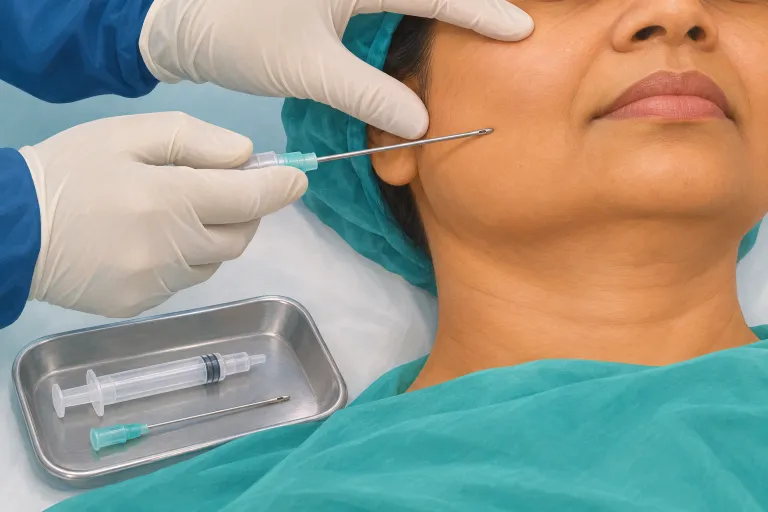
For facial treatment, StatPearls describes harvesting and cleaning fat, then placing small portions through a cannula, a thin tube, into the intended facial sites. Ask the surgeon where they propose collecting fat and which facial areas they propose treating.
Facial areas discussed in StatPearls
StatPearls discusses the temples, forehead, cheeks, under-eye area, lips, nasolabial folds, jawline and chin.
Ask the surgeon to mark the proposed sites on your treatment plan. For each site, ask what change they are aiming for and what the risks are.
What fat transfer can add, and what a facelift addresses
StatPearls describes placing harvested fat into selected facial areas to add volume. The American Society of Plastic Surgeons (ASPS) describes a facelift as repositioning underlying tissue, commonly lifting deeper layers and muscles, then redraping skin and trimming excess skin.
Ask the surgeon to explain which concerns involve adding volume and which involve lifting existing tissue. If both procedures are proposed, ask what each contributes to your plan.
Facial fat transfer with a facelift
The AAFPRS lists fat grafting among procedures that may accompany a facelift. For an explanation of the lifting operation, see facelift in Thailand.
YOUNIFY Clinic lists facial fat transfer as an addition to facelift surgery. Kamol Hospital includes "Facial Fat Restoration with Fat Transfer" among its facelift and associated procedures.
Ask whether the surgeon proposes fat transfer alone or together with lifting surgery. Request an explanation of why the proposed combination addresses your concerns, including what changes you shouldn't expect.
When added volume is only part of the question
The AAFPRS lists fillers, neurotoxins, thread lifts and ultrasound or radiofrequency tightening among nonsurgical options. Its complementary procedures include brow lift, eyelid surgery, neck lift, fat grafting and skin resurfacing.
The BAAPS says facelifts do not get rid of wrinkles around the eyes, forehead and mouth and that Botox injections can help with those, and that laser resurfacing or chemical peels may help with skin texture. It says fat grafting can sometimes be performed instead of or alongside a facelift, and discusses brow lift as another possible option.
Use those distinctions to ask about the concern you want treated. Ask whether the proposed fat placement addresses it, whether another approach deserves discussion, and what choosing no procedure would mean for your plan.
Will transferred facial fat last?
Some fat might be reabsorbed. The NHS says this can happen during the first few months, and the full effect can take up to six months.
StatPearls says evidence about definitive fat-survival rates conflicts.
Ask your surgeon how they explain this uncertainty, when they would assess the result and what they would consider if the remaining volume differs from your goal.
How much does facial fat transfer cost in Thailand?
YOUNIFY Clinic lists facial fat transfer from THB 50,000 when added to a facelift, read 4 November 2026. Ask for the total for your proposed surgery and the inclusions attached to that quote.
For the lifting operation's prices, see facelift costs in Thailand. If you are considering fat transfer alone, request a separate quote with its own anesthesia, hospital and aftercare terms.
Facial fat grafting recovery and aftercare
Discuss the recovery plan for every procedure you are considering. Ask specifically whether adding a facelift changes the instructions for the grafted areas or the place where fat was collected.
Recovery can involve the following:
- Compression: StatPearls says compression garments should be worn for two to three days. Ask which garment and body area this would mean in your case.
- Bruising, swelling and work: The NHS says treated areas will probably be bruised and swollen for a few weeks. It says you may want a couple of weeks off work.
- Vigorous activity: StatPearls advises avoiding vigorous activity for two to three weeks. Ask the surgeon when your own exercise routine can resume.
- Assessing the effect: The NHS gives up to six months for the full effect as some injected fat may be reabsorbed during the first months.
For combined surgery, see facelift recovery in Thailand. Request separate answers about wound care, facial pressure, washing and follow-up appointments for your proposed operation.
Risks and uncertainties to discuss with the surgeon
The NHS general surgical fat transfer guide lists these possible complications:
- Hematoma, a collection of blood under the skin
- Fat necrosis, meaning death of fat tissue
- Fat embolism, a blood vessel blockage caused by fat
- Pneumothorax, air leaking into the space between the lungs and chest wall
- Thick, obvious scars
The same NHS guide says any operation carries a small risk of excessive bleeding, a blood clot in a vein, infection or an allergic reaction to the anesthetic. Ask which risks apply to the proposed facial procedure and fat collection technique.
StatPearls' facial fat grafting reference lists bruising and swelling, overcorrection, and undercorrection from insufficient volume or excessive reabsorption. It also lists infection, scarring, tissue bunching, uneven contours, nodules or calcium deposits, pain or shape changes at the collection site, and graft loss.
The same reference lists blindness, stroke and fat embolism. It describes blindness as rare and explains that fat can block an artery after high-pressure injection.
Ask the surgeon to explain how they reduce these risks and respond to a suspected complication. Request written instructions about symptoms that need urgent assessment, where to seek care and whom to contact after returning home.
Planning facial fat transfer in Thailand
YOUNIFY's face and neck lift page says patients usually plan 10 to 14 days in Bangkok. It describes a "First review in Bangkok before you fly" and says follow-up after returning home is available through WhatsApp.
For procedures under general anesthesia, YOUNIFY lists consultation, preoperative tests, a surgeon and anesthesiologist, medication, dressings and one follow-up visit among its inclusions. It also lists "One night in hospital".
Ask any clinic quoting a combined operation to confirm which of those terms apply. Request the hospital name, appointment dates and a written inclusion list for the exact plan being quoted.
Questions to put in writing before booking
Request a written surgical plan and an itemized quote.
- Is facial fat transfer proposed alone or with a facelift, and why?
- Where will fat be collected and placed?
- What anesthesia is proposed, and how many hospital nights are planned?
- Which preoperative tests are included, and who reviews them?
- What medication, dressings and follow-up visits are included?
- When is the in-person review, and who assesses whether I can fly?
- What support is available after I return home, and who handles an urgent problem?
- What are the terms for further treatment, revision surgery or complication care?
- Are accommodation, flights and transport included or arranged separately?
Ask for the surgeon's answers alongside the booking terms. If the plan changes after consultation, request an updated procedure list and total before committing.
Thai clinic facelift instructions to compare with your plan
Phuket Plastic Surgery Institute (PPSI) publishes instructions specifically for facelift surgery. It asks patients to disclose existing conditions, drug allergies, medication, dietary supplements and vitamins.
PPSI asks patients to refrain from pain medication, nonsteroidal anti-inflammatory drugs and vitamin supplements for at least seven days before surgery. It strongly recommends stopping alcohol and smoking, including electronic cigarettes, for at least one week beforehand. Source: PPSI's facelift instructions.
Ask your surgeon and the clinician who prescribes your medicines to confirm your medication plan. Ask which preparation instructions apply when fat transfer is added.
PPSI's facelift aftercare includes "Please take medications as prescribed by your surgeon." It describes cold compression for the first five days, sleeping with the head raised above the chest and keeping the wound dry. Source: PPSI.

The PPSI page schedules surgeon follow-up and stitch removal at 10 to 14 days. Ask for specific instructions on compresses and pressure over grafted areas, rather than applying facelift instructions to those sites yourself.
In this section: facelift in Thailand, facelift in Bangkok, what a facelift costs in Thailand, deep plane facelift, how long it lasts facelift, mini facelift, facelift recovery, smas facelift and types facelift.
Frequently asked questions
What is facial fat transfer?
It uses fat collected from your own body and placed into facial sites, as described by StatPearls. The NHS describes collection, separation from blood and fluid, then injection, and also calls surgical fat transfer a fat graft or lipomodelling.
What areas of the face can fat grafting treat?
StatPearls discusses the temples, forehead, cheeks, under-eye area, lips, nasolabial folds, jawline and chin. Ask which areas, if any, the surgeon proposes treating and why.
Can fat transfer be done with a facelift?
Yes. The AAFPRS lists fat grafting as a possible accompanying procedure, and YOUNIFY lists it as a facelift addition. Ask the surgeon whether that combination fits your goals and health.
Does fat transfer to the face last forever?
Some injected fat may be reabsorbed during the first months, according to the NHS. StatPearls says definitive survival-rate evidence conflicts. Ask what retained volume the surgeon expects in your case and how they explain the uncertainty.
What are the downsides of fat transfer to the face?
StatPearls lists uneven contours, excess or insufficient volume, swelling, infection and collection-site problems among the risks. It also lists blindness, stroke and fat embolism, describing blindness as rare. Ask how each risk would be recognized and treated.
Read next
- Types of Facelift: Mini, SMAS, Deep Plane and Neck LiftUnderstand facelift names by treatment area, tissue approach and extent. Compare mini, SMAS, deep plane and neck-lift questions for a Thailand consultation.
- How long a facelift lasts, by techniqueWhat sources say about facelift longevity, ageing after surgery, technique differences, recovery milestones and revision questions.
- What facelift costs in ThailandEvery published hospital and agency facelift price we found, with what each includes and the date we read it.
- Facelift in BangkokBangkok hospitals and clinics that print a facelift price, with what each includes.
Ask When Facial Fat Transfer May Be Combined With a Facelift
Tell us the procedure, your budget and your dates, and any hospitals you are considering.
Get My Free Quote →Free, no obligation. Nothing goes to a clinic without your OK.