How Long Do Breast Implants Last?
Breast implants aren't lifetime devices, but reaching 10 years doesn't automatically mean they need to be replaced. The FDA's 2011 summary says routine replacement isn't necessary, while Cleveland Clinic reports an American Society of Plastic Surgeons (ASPS) recommendation to remove or replace implants every 10 to 15 years.
Cleveland Clinic adds that your surgeon may not recommend removal if you have had no complications.
If you are considering breast augmentation in Thailand, ask your surgeon how they would monitor your implant and what follow-up is available after you return home.
Clinics cannot pay to be listed or ranked higher on AsiaPatient.
Do breast implants need to be replaced after 10 years?
The UK National Health Service (NHS) says some women may need more surgery after about 10 years. Its reasons include implant problems and changes in the breasts around the implants.
The 2021 UK professional guide says: "Routine implant replacement after a specified time is not recommended." It was published jointly by the Association of Breast Surgery, the British Association of Aesthetic Plastic Surgeons and the British Association of Plastic, Reconstructive and Aesthetic Surgeons.
Ask your surgeon whether the reason for a proposed operation is an identified implant problem, a change you want, or advice based on the particular device. Ask what continued monitoring would involve if you keep it.
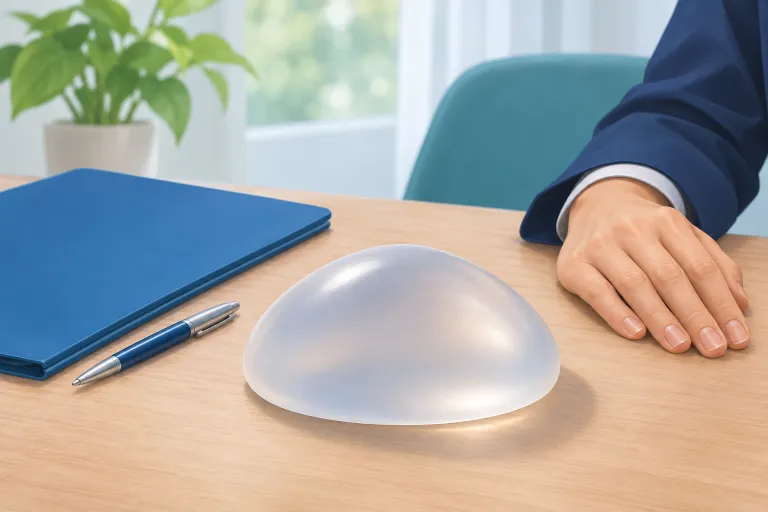
What the FDA says about routine replacement
The FDA's 2011 summary says many women will need additional surgery to modify, remove or replace implants, even though routine replacement isn't necessary. Not every later operation means an implant must be replaced.
The FDA's complication guide lists removal with or without replacement among possible repeat operations. It also lists surgery on the surrounding scar tissue and repositioning an implant.
Why an implant might need attention sooner
ASPS lists leakage or rupture, persistent pain and capsular contracture among implant risks. The NHS describes capsular contracture as hardening caused by scar tissue shrinking around the implant.
The FDA defines rupture as a tear or hole in the implant shell. It considers Baker grades III and IV, the severe grades of capsular contracture, and says these may require another operation.
Cleveland Clinic also lists leaking and implant movement as reasons people may seek removal. The NHS lists folds, rotation and rippling among possible problems.
Monitoring when there is no obvious problem
For silicone-gel implants in people without symptoms, the FDA labeling guidance says the first ultrasound or magnetic resonance imaging (MRI) scan should be performed five to six years after surgery. It then advises imaging every two to three years.
These are scans used to check for rupture.
The same FDA guidance recommends MRI when symptoms occur or an ultrasound result is uncertain. Ask your clinician which imaging applies to your implant, who will arrange it where you live, and what follow-up care is available.
Symptoms and changes that need prompt clinical review
The FDA's complication guide describes fluid collecting around an implant, called a seroma, which may cause swelling or pain. Ask your clinician to assess new hardening, pain or changes in shape or position.
The FDA's BIA-ALCL guidance identifies persistent swelling, a mass or pain around an implant as main symptoms. BIA-ALCL means breast implant-associated anaplastic large cell lymphoma, a cancer of the immune system.
The FDA considers an individual's risk low, but describes the cancer as serious. Ask for a clear contact route for these changes rather than waiting for the next routine appointment.
What the reoperation and rupture figures mean
Reoperation means another operation. Rupture means a damaged implant shell.
| Source and measure | Population and country | Follow-up | Reported figure | Context |
|---|---|---|---|---|
| FDA 2011 safety summary: reoperation and removal | US silicone-gel implant studies; augmentation patients | First 8 to 10 years for reoperation; within 10 years for removal | Reoperation: 20% to 40%. Device removal: as many as one in five primary augmentation patients | Augmentation figures only; reconstruction patients had separate results |
| FDA 2020 example checklist: rupture or leakage and reoperation | Illustrative figures from published safety and effectiveness summaries for approved implants | No single follow-up period attached to these example figures | Rupture or leakage: up to 31.2% of patients. Reoperation: up to 59.7% | Example figures the FDA calls illustrative |
| UK professional guide, 2021: reoperation and rupture | UK professional-body guidance; rupture passage cites a US Core study | Annual and 10-year reoperation context; 10 and 15 years for rupture | About 1% reoperation a year; about 10% after 10 years. The cited study suggested one in 10 implants had ruptured at 10 years; the guide estimates half may rupture by 15 years | The 15-year statement remains an estimate, with "may" retained |
| Maxwell et al., 2015: one prospective multicenter study | 941 people across augmentation, augmentation revision, reconstruction and reconstruction revision; one implant model (Natrelle 410); authors affiliated with US institutions and the manufacturer | Study reports 10-year outcomes; one third underwent MRI screening every two years | 5.7% overall confirmed ruptured implants among those screened with MRI | Mixed procedures; screened subgroup |
| Outcomes in primary breast augmentation, 2015: one single-surgeon study | 1,539 primary bilateral augmentation patients; single surgeon. | 0 to 155 months; average 18 months | Reoperation: 7.7% | The database covered 15 years; average patient follow-up was much shorter |
The FDA guidance explicitly calls its example percentages illustrative. Ask for the patient information for your proposed implant and the figures for a first breast augmentation, including how long patients were followed.
Breast implant warranties: what manufacturers print
GC Aesthetics says its warranty for rupture or capsular contracture covers the product only and excludes surgery costs. Motiva describes programs that may add financial assistance, subject to their terms.
The benefit might be limited. Ask separately about the replacement device, surgical expenses and travel, and request the terms that apply to implantation in Thailand.
| Manufacturer or program | Event and benefit printed | Duration or eligibility printed | What to confirm for Thailand |
|---|---|---|---|
| Motiva Q Inside extension and 5Y program | Financial aid for rupture or Baker III or IV capsular contracture; eligible 5Y patients may receive assistance alongside a replacement product | One free year of extended cover when Q Inside implants are registered within 90 days; a paid five-year program is also offered | Exact implant eligibility, enrollment charge, registration deadline and local financial terms |
| Silimed | Product replacement for proven rupture due to a manufacturing defect; the program also names Baker III or IV contracture | Lifetime replacement for the specified manufacturing-defect rupture | Contracture conditions and duration; additional financial assistance on this page is expressly UK-only |
| Sebbin instructions for use | Replacement of a product Sebbin identifies as defective at the time of shipping | The promise is tied to the defect at shipping | Applicable product terms, claim process and who pays for surgery |
| GC Aesthetics, Nagor or Eurosilicone | Product-only cover for rupture or capsular contracture; surgery costs excluded | Applies to products implanted after 1 January 2009 by an appropriately qualified and licensed physician using accepted techniques | Applicable implant and full eligibility conditions |
| POLYTECH, IMPLANTS OF EXCELLENCE | Supply of a replacement implant in specified cases | Ask for the covered events and their durations | Registration requirements and any contribution toward surgical costs |
Motiva's separate US warranty brochure prints free replacement for rupture and up to US$3,500 for uncovered fees and costs for up to 10 years. That is the US brochure's wording; ask which program applies to your Thai operation before including any contribution in your budget.
For device names and the brands hospitals list, see breast implant brands in Thailand.
What Thai clinics print about follow-up and warranty cover
Yanhee's Motiva page attributes warranty terms to Establishment Labs, the manufacturer. Ask the hospital for its own follow-up and revision terms alongside those manufacturer documents.
Follow-up before flying home
Yanhee advises planning seven to 10 days in Bangkok for a "follow-up and stitch check" before flying. This is its published augmentation schedule.
Bangkok Hospital Pattaya says: "Sutures are removed approximately 1 week after surgery" and tells patients to attend follow-up appointments.
Phuket Plastic Surgery Institute (PPSI) suggests staying in Thailand for approximately two weeks "for your surgeon to monitor your improvement after surgery."
Wansiri Hospital prints a "Follow-up Period" of one week, one month, three months and six months. Ask how later appointments work after you return home.
Ask the treating surgeon to confirm your departure plan and which appointments need to happen first. The separate breast augmentation recovery guide covers the broader recovery questions.
What the clinic and agency pages say about warranty or revision
Yanhee's Motiva page describes free device replacement for rupture for the device's lifetime. It describes replacement for Baker III or IV capsular contracture for 10 years, and says: "Both cover the device only, not the surgery to put it in."
The agency CosMediTour says its implants carry either a 10-year or an unlimited manufacturer warranty against structural defects. Ask which implant and warranty document that statement refers to in your proposed operation.
Planning before you leave Thailand
The NHS advice on cosmetic surgery abroad says overseas clinics may not offer follow-up treatment, or may offer it to a different standard. It advises asking what happens if more surgery is needed.
Request the follow-up plan and warranty terms in writing.
In this section: breast augmentation in Thailand, breast augmentation in Bangkok, best clinics breast augmentation, what breast augmentation costs in Thailand, fat transfer breast augmentation, gummy bear implants breast augmentation, implant brands breast augmentation, is it safe breast augmentation, packages breast augmentation, breast augmentation recovery, scars breast augmentation, teardrop vs round breast augmentation, breast augmentation in Phuket, reviews breast augmentation, implant size breast augmentation and implant placement breast augmentation.
Frequently asked questions
How long do breast implants last?
The FDA says implants aren't lifetime devices and complications become more likely the longer they remain implanted. Cleveland Clinic reports a 10 to 15 year removal-or-replacement recommendation, with the caveat that a surgeon may not advise removal without complications.
Do breast implants need to be replaced every 10 years?
The FDA's 2011 summary says routine replacement isn't necessary. Cleveland Clinic's separately reported 10 to 15 year recommendation includes its no-complication caveat; discuss your implant's condition with your surgeon.
What happens after 10 years with breast implants?
In the FDA's 2011 summary, as many as one in five primary augmentation patients needed device removal within 10 years. The same source says routine replacement isn't necessary.
What is the breast implant rupture rate?
In one 2015 study of a single implant model (Natrelle 410), the overall confirmed ruptured-implant rate was 5.7% in the MRI-screened subgroup. The study reported 10-year outcomes across mixed procedures.
Do breast implants get hard over time?
The NHS lists hardening from scar tissue shrinking around an implant as a possible problem, called capsular contracture. The FDA says severe grades may require another operation; ask a clinician to assess any new firmness or pain.
Does a breast implant warranty pay for replacement surgery?
Some programs cover the device only: GC Aesthetics expressly excludes surgery costs. Motiva describes conditional financial assistance under extended programs, so ask for the applicable terms and a written breakdown of any expenses you would pay.
Read next
- Teardrop or round implants: shape, rotation and what studies reportHow teardrop and round implants differ in shape and surface, what studies report on appearance and rotation, and what Thai clinics print about each.
- Breast augmentation cost in ThailandPublished hospital prices with what each includes, agency add-ons and the full trip budget.
- Breast augmentation packages in ThailandWhat hospital and agency packages include line by line, what they leave out, and what an agency adds over booking direct.
- Fat Transfer Breast Augmentation Thailand: Costs (2026)Compare Thai clinics' printed breast fat-transfer prices, sessions and limits, with society guidance, two reviews and an implant price comparison.
Ask a Thai Surgeon What Follow-Up and Warranty Come With Your Implant
Tell us the procedure, your budget and your dates, and any hospitals you are considering.
Get My Free Quote →Free, no obligation. Nothing goes to a clinic without your OK.