Eyelid surgery scars: incision lines and healing by procedure
Eyelid surgery can leave a scar. Upper eyelid incisions generally follow the natural lid crease, while lower eyelid incisions can sit below the lashes or inside the lid, according to the UK National Health Service (NHS).
The NHS says scarring may be visible and feel tight for a few months.
If you're considering eyelid surgery in Thailand, ask the operating surgeon to mark the proposed incision before you agree to surgery. Ask where the line would start and end, and what visibility to expect while it heals.
Clinics cannot pay to be listed or ranked higher on AsiaPatient.
Where eyelid surgery incision lines can sit
The NHS describes an upper incision in the natural fold and lower incisions below the lashes or inside the lid. Use those locations to ask about your own surgical plan.
| Procedure route | Incision location | External skin incision? |
|---|---|---|
| Upper eyelid surgery | Natural lid crease, according to the NHS | Yes |
| Lower eyelid surgery, external route | 1 to 2 mm below the lash line, or within a preexisting crease, in EyeWiki's description | Yes |
| Lower eyelid surgery, internal route | Inside the lid, described by Yanhee International Hospital as transconjunctival | No skin incision for this approach |
For the differences between operations, see types of eyelid surgery. At the consultation, ask the surgeon to identify every incision included in the proposed operation, including any additional work.
Upper eyelid surgery: the natural lid crease
The NHS says upper eyelid surgery generally involves a cut along the crease in the eyelid's natural skin fold. An incision is the surgical cut; ask the surgeon to show you where yours would sit.
Ask to see the planned line with your eyes open and closed. Ask whether any part would extend beyond the fold and, if so, where that part would lie.
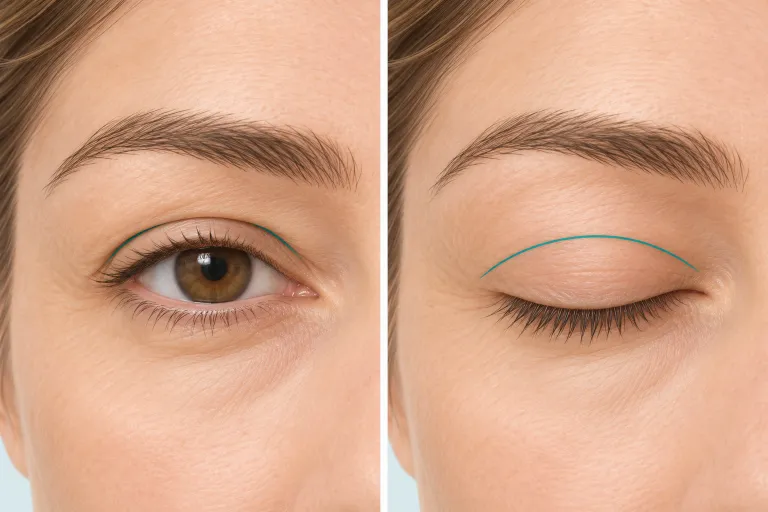
Bring your concern about visibility into that discussion. For example, ask what you might notice in everyday conversation and what you might see when looking closely with your eyes closed.
Lower eyelid surgery: just below the lash line
EyeWiki, from the American Academy of Ophthalmology, describes a skin incision 1 to 2 mm below the eyelash line or within a preexisting crease just below the lashes. It calls this an infraciliary incision, meaning below the lash line.
Ask the surgeon to show the full proposed line, including its outer end. The distance below the lashes is only one part of the location you want explained.
If you're discussing lower eyelid surgery, ask whether the plan uses an external or internal route. Have the surgeon explain why that route is proposed for you and whether any additional skin incision is planned.
Lower eyelid surgery from inside: no skin incision
Yanhee International Hospital in Bangkok says lower surgery can, in some cases, use "an internal (transconjunctival) approach with no skin incision." Transconjunctival refers here to the route inside the lower lid.
An internal approach may be used only in some cases. Ask the operating surgeon whether it is appropriate for your proposed surgery, and have them explain the complete incision plan.
If the surgeon proposes additional work, ask where each additional cut would sit. Keep the explanation specific to what you would have done, rather than choosing from the procedure name alone.
What to expect as an eyelid scar heals
The NHS includes noticeable scarring among possible problems after eyelid surgery. Ask the surgeon to discuss both the planned incision location and the possibility of a scar that remains noticeable.
Visible and tight for a few months
The NHS states: "Scarring may be visible and feel tight for a few months."
Ask your surgeon what they expect for your operation and when they want to assess the line again. A scar might still show during healing.
At follow-up, describe what concerns you: its appearance, the feeling of tightness, or both. Ask whether the change needs an examination and when the surgeon wants to hear from you again.
If you have an event or a return-to-work date in mind, tell the surgeon before booking. Ask what appearance to plan for at that point, rather than treating a few months as a fixed deadline for your scar.
Raised scarring and keloid
One 2023 systematic review of scarring after eyelid procedures searched PubMed in May 2022 and included 34 English-language articles. Thirteen of them reported hypertrophic, or raised, scarring, in 36 of 3,650 patients. The review covered eyelid procedures beyond cosmetic blepharoplasty.
The review also identified a keloid after a different eyelid operation called tarsorrhaphy. For the cosmetic procedures, its finding was: "No articles reported a keloid as an outcome of strictly cosmetic procedures."
The overall count concerns a broader group of eyelid operations, while the keloid finding specifically addresses cosmetic procedures. Ask your surgeon how the published findings relate to your proposed operation and your own history of healing.
If you've had a scar that became raised after another operation or injury, describe it at the consultation. Ask whether the surgeon wants to examine it and whether it changes the discussion about your eyelid surgery.
Ask what would prompt a further appointment if the eyelid scar becomes raised. Have the surgeon explain how they would assess it before discussing any treatment.
The first follow-up period
Ask for your follow-up appointments in writing before surgery. Include the wound review and any stitch-removal appointment, with a contact for concerns between visits.
For broader recovery questions, see eyelid surgery recovery. Confirm the schedule with your operating surgeon for the exact operation planned.
Early follow-up and stitch removal
EyeWiki's lower eyelid surgery guidance says cold compresses are often recommended to reduce swelling in the first 48 hours. Ask your surgeon for the instructions that apply to you.
The same guidance describes a follow-up within a week and removal of non-absorbable stitches 5 to 7 days after surgery. These are stitches that need removal, rather than dissolving on their own. EyeWiki gives this timing for lower eyelid surgery.
Ask whether your closure uses stitches that need removal and who will remove them. Get the appointment date from the treating team.
If you'll return home abroad, ask which appointments should happen before departure and how later scar concerns will be assessed. Confirm whom to contact after you leave Thailand and where to seek an examination if one is needed.
When to contact the surgeon
EyeWiki says patients should receive instructions about concerning symptoms that suggest bleeding or infection and require contact with their surgeon. Ask the team to explain those symptoms before you leave after surgery.
Keep the contact details with your postoperative instructions. Ask who answers outside clinic hours and what to do if you can't reach the operating surgeon.
Before surgery, get clear answers to these follow-up questions:
- Which changes in the incision should I report straight away?
- When does tightness need an examination?
- Who checks a scar that becomes raised or remains concerning?
- Where should I seek urgent care if I'm away from the treating hospital?
Frequently asked questions
Where is an upper eyelid surgery scar likely to sit?
The NHS describes the incision along the natural upper-lid crease. Ask your surgeon to mark the proposed line and explain its full extent, including any part outside the fold.
Where can a lower eyelid surgery incision sit?
The NHS lists two locations: below the lower lashes or inside the lower lid. Ask which route your surgeon plans and whether there would be any additional skin incision.
Does lower eyelid surgery always leave a visible external scar?
Yanhee describes an internal approach that uses no skin incision in some cases. Ask your surgeon whether that approach fits your proposed operation and where any other planned incisions would sit.
How long can an eyelid surgery scar be visible or feel tight?
The NHS says this may last a few months. Ask your surgeon when they want to review persistent tightness or a line whose appearance concerns you.
What did a systematic review report about hypertrophic scars and keloids after eyelid procedures?
The 2023 review reported raised scarring in its broader eyelid-procedure population. It identified a keloid following tarsorrhaphy, while none of its included articles reported keloid after strictly cosmetic procedures.
Ask the surgeon how those findings apply to the exact operation under discussion.
When should a patient contact the surgeon during early recovery?
EyeWiki's guidance calls for surgeon contact when symptoms suggest bleeding or infection. Ask for the specific warning signs and the urgent contact route in writing before surgery.
Read next
- Double eyelid surgery: incision vs suture methodsHow incisional and suture (non-incisional) double eyelid surgery differ, recovery and risks studies report, and what Thai hospitals print about it.
- Lower eyelid surgery for under-eye bagsHow lower eyelid surgery treats bags and loose skin, incision options, recovery, risks and what Thai hospitals and clinics print about treatment.
- Ptosis surgery for droopy eyelidsWhat ptosis surgery repairs, how it differs from cosmetic eyelid surgery, recovery, risks and questions to ask a Thai surgeon.
Ask a Surgeon Where Your Incision Would Sit
Tell us the procedure, your budget and your dates, and any hospitals you are considering.
Get My Free Quote →Free, no obligation. Nothing goes to a clinic without your OK.