Brow Lift or Eyelid Surgery: What Fixes Hooded Upper Lids?
The main difference is that a brow lift raises a descended eyebrow, while upper blepharoplasty, or upper-eyelid surgery, removes or repositions extra eyelid tissue. Some patients may need a brow lift, blepharoplasty or both after a clinician assesses the cause of the hooding.
Hooded upper lids can involve a low brow, excess eyelid skin, a low lid edge called ptosis, or overlapping findings, as the American Academy of Ophthalmology (AAO) EyeWiki explains. Its upper-eyelid assessment includes brow position, lid tissue, lid opening and eye-surface health before a clinician discusses surgery.
Clinics cannot pay to be listed or ranked higher on AsiaPatient.
Why hooded upper lids can have more than one cause
StatPearls describes hooding at the outer upper lid as a possible combination of a descended outer brow and excess eyelid skin. More than one finding might be involved.
Excess lid skin and a low brow are different findings
AAO EyeWiki describes brow ptosis as descent of the soft tissues of the brow. Dermatochalasis means excess eyelid skin, which can occur alongside a low brow.
Cleveland Clinic describes blepharoplasty as surgery that removes or repositions extra skin, fat and muscle around the eyes. Its brow-lift guide describes raising descended eyebrows.
At a consultation, ask the clinician to explain which tissue contributes to the hooding you want assessed. Ask them to distinguish the brow position from the skin on the upper lid.
Ptosis is a separate question
AAO EyeWiki's ptosis guide defines blepharoptosis as an abnormally low upper-lid margin when looking straight ahead. The margin is the edge of the eyelid.
The same source distinguishes this from excess skin and brow descent because surgical management differs. Ask whether the proposed assessment includes the height and movement of the lid itself.
What upper blepharoplasty can address, and what it can't
The UK National Health Service (NHS) describes upper-eyelid surgery as a procedure that generally removes excess eyelid skin, fat or muscle through an incision in the natural lid fold. Ask which tissues the surgeon proposes to treat in your case.
Cleveland Clinic states that blepharoplasty alone can't reposition the eyebrow. If brow position is part of your concern, ask the surgeon to address that finding explicitly in the consultation.
For an operation described simply as an "eyelid lift," ask for the exact procedure name. Ask whether the plan concerns excess tissue, the lid margin, or additional brow work.
What a brow lift can address
Cleveland Clinic describes a brow lift as raising and reshaping descended eyebrows. For the broader procedure overview, see brow lift in Thailand.
AAO EyeWiki says age-related brow descent typically appears first in the outer third of the brow. Ask the clinician whether brow descent is present and which part of the brow is involved.
Technique is a separate decision
AAO EyeWiki lists several approaches to brow repositioning, including temporal, direct and endoscopic procedures. Ask the surgeon to name the proposed approach and explain its purpose in your plan.
The endoscopic brow lift in Thailand guide covers that technique separately. A consultation about hooding should also explain whether upper-lid tissue or the lid margin needs separate consideration.
When both procedures may be discussed
AAO EyeWiki says patients with significant brow ptosis may need concurrent brow lifting. Its brow-ptosis guidance says people considering blepharoplasty should be evaluated for brow repositioning, with combined treatment if necessary.
Ask for the clinical reason for each proposed operation. Don't assume a combined package is the starting plan.
Questions to take to the consultation
Use these questions to ask the surgeon about the findings and proposed scope:
Request the procedure names in the written plan. Ask the surgeon to explain any difference between the operation you initially asked about and the operation they propose after examining you.
Clinician assessment comes before a treatment decision
AAO EyeWiki includes medical and eye history, dry-eye symptoms, medicines and supplements in its assessment. Tobacco and alcohol use also form part of that review.
Bring your medicine and supplement list to the consultation. Describe any dry-eye symptoms and previous eye treatment, and ask how those details affect the proposed plan.
Brow position, lid skin, lid opening and the eye surface
AAO EyeWiki describes checking for ptosis, assessing brow position and examining lid closure. The examination also considers the tear film, the moisture layer over the eye, vision and visual fields where relevant.
Its brow assessment describes a clinician stabilizing and lifting the brow to distinguish excess eyelid skin from hooding affected by brow descent.
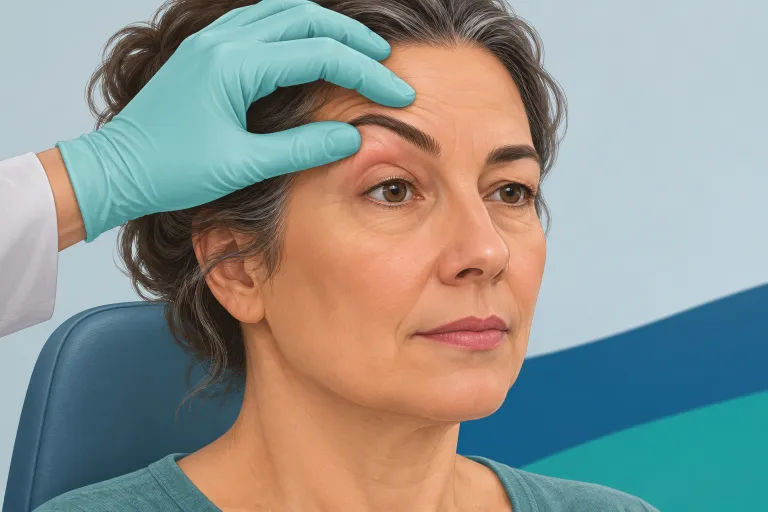
Ask the clinician to explain the findings before discussing an operation. If both the brow and upper lid are involved, ask how each finding changes the proposed treatment.
Functional symptoms and cosmetic concerns need separate documentation
AAO EyeWiki distinguishes functional visual symptoms from cosmetic concerns when describing reasons for upper blepharoplasty. Explain both what you notice about your appearance and any difficulty with vision.
StatPearls describes outer-lid hooding that can interfere with upper or outer-upper vision. It also lists difficulty seeing traffic lights, and reading with down-gaze ptosis, among functional reasons for upper blepharoplasty.
Ask which symptoms need testing and how the findings will be documented. Keep that discussion separate from the changes you want in appearance.
Recovery and risks are specific to the procedure discussed
Ask the treating team for instructions covering every operation in your proposed plan.
| Topic | Upper eyelid surgery | Brow lift | How to use this |
|---|---|---|---|
| Early care | AAO EyeWiki: ice compresses frequently for the first 3 days, then warm compresses | Cleveland Clinic: cold compresses for 48 hours, head elevated when resting | General aftercare |
| Review or stitch removal | AAO EyeWiki: postoperative review within 1 to 2 weeks | Cleveland Clinic: stitches removed at about one week | Review timing |
The NHS says most people take about 2 weeks off work after eyelid surgery, depending on their job. It says bruises and redness may take several weeks to fade.
Ask separately about wound care, returning to work and resuming exercise. For more detail on the brow procedure, see brow-lift recovery in Thailand.
Risks to discuss with the treating clinician
AAO EyeWiki lists these among upper-blepharoplasty risks:
- Bleeding, infection and poor healing
- Scarring and uneven appearance
- Incomplete eyelid closure, eye-surface exposure or dry eye
- Rare vision loss
Cleveland Clinic lists these among brow-lift risks:
- Temporary forehead or hair numbness or itching
- A small amount of hair loss at the incision
- Bleeding beneath the forehead skin and prolonged swelling
- Rare injury to the nerve that raises the eyebrow
Ask the surgeon to explain the risks for each proposed operation. Request written information about symptoms that need a call, whom to contact and where you would be assessed.
Thailand planning starts with a written clinical and follow-up plan
Yanhee International Hospital's public eyelid-surgery page describes its operation as "a day case with no overnight stay." Ask the treating hospital whether your proposed operation has that admission arrangement.
Before arranging your stay, request written answers to these questions:
If more than one procedure is proposed, ask for a follow-up schedule covering both. Ask what arrangements apply if the treating team wants an additional review before you leave.
Price context belongs on the cost guide
See brow-lift costs in Thailand for the separate price guide. Request a quote using the exact operation name from your clinical plan.
If the proposal includes upper blepharoplasty or ptosis repair, ask the hospital to identify that work separately in writing. Request the inclusions, exclusions and follow-up arrangements for the full proposed scope.
Related procedures: upper eyelid surgery and types of eyelid surgery.
Frequently asked questions
Is a brow lift the same as upper blepharoplasty?
No. Cleveland Clinic describes blepharoplasty as removing or repositioning extra tissue around the eyes, while its brow-lift guide describes raising the eyebrows.
Can upper eyelid surgery lift my eyebrows?
Cleveland Clinic says blepharoplasty alone can't reposition the eyebrow. Ask the surgeon whether brow position contributes to the concern you're describing.
Are my hooded upper lids caused by a low brow or excess eyelid skin?
A clinician needs to assess that. StatPearls describes outer-lid hooding that combines brow descent with excess eyelid skin, so both can be present.
Can a brow lift and eyelid surgery be done together?
AAO EyeWiki describes treating brow ptosis alongside blepharoplasty if necessary after assessment. Ask why both procedures are proposed and what each is intended to address.
How does ptosis differ from a low brow or excess eyelid skin?
AAO EyeWiki defines ptosis as a low upper-lid margin and distinguishes it from excess skin and brow descent. Its surgical management differs, so ask whether lid-margin position is part of your assessment.
Is recovery different after a brow lift and upper eyelid surgery?
AAO EyeWiki describes upper-eyelid aftercare and a postoperative review, while Cleveland Clinic gives brow-lift aftercare and stitch-removal guidance. Request instructions for the operation or operations proposed, including your work and activity questions.
What should I ask a Thailand hospital before choosing between them?
Ask for the clinician's findings, the purpose of each proposed operation and the written follow-up schedule. Confirm admission arrangements, included services and whom to contact after you return home.
Read next
- Brow lift cost: Thailand beside the US, UK and AustraliaWhat Thai hospitals print for a brow or forehead lift, what US, UK and Australian sources give, and what each price covers.
- Brow lift recovery: the timeline and the trip homeWeek by week after a brow or forehead lift: swelling, numbness, scars, return to work and the main risks, and what Thai hospitals print about stay.
- Endoscopic brow lift vs other brow lift techniquesHow an endoscopic brow lift works, how it differs from coronal, hairline and temporal lifts, recovery, risks and what Thai hospitals print.
Ask a Surgeon Whether the Brow, the Lid or Both Are Involved
Tell us the procedure, your budget and your dates, and any hospitals you are considering.
Get My Free Quote →Free, no obligation. Nothing goes to a clinic without your OK.