Lower body lift scars: incision patterns and healing after skin removal
According to The Aesthetic Society, a complete lower body lift leaves an incision line around the lower torso, across the front, sides and back. Its recovery guidance says the scars are permanent and should be concealable with clothing. If you're considering a body lift in Thailand, ask the operating surgeon to draw the proposed line and discuss where it would sit under your clothes.
Clinics cannot pay to be listed or ranked higher on AsiaPatient.
Where a lower body lift scar runs
The circumferential scar, front, sides, and back
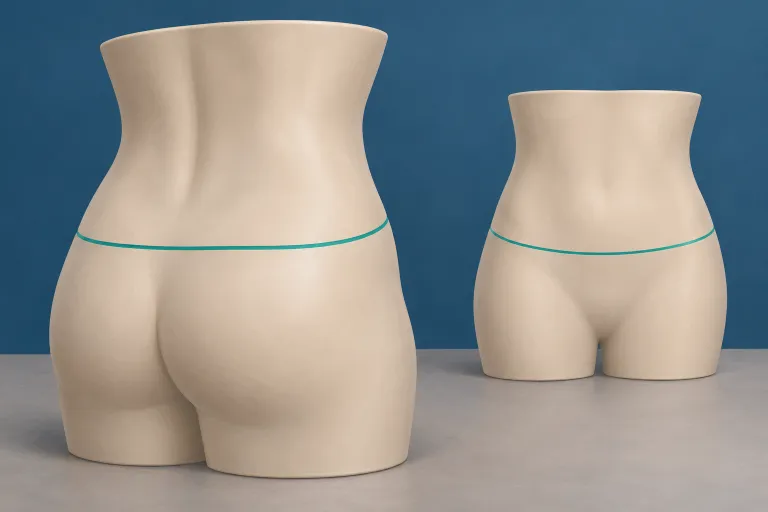
Circumferential means around the body. The American Society of Plastic Surgeons (ASPS) uses the term for an incision that allows removal of a belt of excess skin and fat.
The Aesthetic Society's description extends the tummy-tuck incision completely around the lower torso. That means considering the line across the front, along the sides and across the back when discussing the scar.
Ask to see the whole proposed incision drawing, including its back view. For a lower body lift, ask the surgeon which areas the operation would address and how those areas relate to the planned line.
Why the incision length and pattern vary
The Aesthetic Society says incision length and pattern depend on how much extra skin you have and where it is. Your incision pattern may differ.
The ASPS body-lift brochure also describes additional incisions that may resemble a bikini-bottom pattern. Ask whether any additional incisions are part of your proposed operation, and have each one marked on the drawing.
How the scar plan can differ
| Decision point | Source description | Ask your surgeon |
|---|---|---|
| Line around the torso | ASPS describes a circumferential incision around the body | Where would the line sit at the front, sides and back? |
| Additional incisions | ASPS says these may resemble a bikini-bottom pattern | Would my plan include any additional lines? |
| A gap at the center of the back | One study describes leaving a strip of skin between the incisions | Could that approach suit me, and why or why not? |
When the scar plan may not go all the way around
A gap at the center of the back
One retrospective study of near-circumferential outpatient outer-thigh and buttock lifts describes this approach.
The study describes preserving a skin bridge at the center of the back to avoid a continuous scar there. In plain terms, a strip of skin remains between the incisions instead of joining them across the back.
The study's surgical planning aimed to conceal the scar beneath underwear and bikini bottoms. Ask the operating surgeon whether a plan that stops short of a full circle would fit your needs and where its incisions would end.
Another incision plan to discuss
The same study mentions "an oblique flankplasty in combination with lipoabdominoplasty, avoiding a circumferential scar." If a surgeon proposes that combination, ask them to explain the procedures and draw each incision.
Ask why they propose that plan for you and which areas it would address. Have them explain how the expected scar placement differs from the complete lower body lift they would otherwise consider.
What permanent scarring means as body lift scars heal
Scars fade, but remain
The Aesthetic Society says scars are permanent and that "they will fade in about twelve months". Fading describes a change in appearance; the scar remains.
Ask your surgeon what changes they expect in your case and when they would review the scar's appearance.
How lower body lift scars look at one year and later
At 6 to 12 months, a lower body lift scar may still have some redness or uneven texture. ASPS describes this phase of surgical scar healing as a time when the tissue starts flattening and redness decreases.
For lower body lifts specifically, the International Society of Aesthetic Plastic Surgery (ISAPS) says softening can continue for 12 to 18 months or longer. It lists skin quality, wound tension, individual healing and postoperative care among the factors affecting the scar.
Tension means pulling on the healing skin. In an ASPS interview, surgeon Suzanne Trott explains that this can stretch a scar, leaving it wider, thicker and red or brown.
For raised scars, ASPS describes steroid injections to change their size and texture. Its scar-healing article also quotes surgeons describing silicone gel or tape for smoothing and laser treatment for redness.
For a wide scar, skin tension matters when considering revision. Surgical revision can remove a scar and close the wound again, but Trott warns that doing this under high tension can leave an equally poor or worse scar.
Questions about your own scar
Ask what the surgeon expects for the surgical scar's color, width and thickness. If you have an existing scar that concerns you, ask whether it affects their assessment or incision plan.
Before agreeing to surgery, ask which aspects of the eventual appearance remain uncertain. Request an explanation of how the surgeon would assess your scar during follow-up, including whom to contact with concerns between appointments.
Clothing and swimwear placement
Scar visibility and the bikini-line goal
The Aesthetic Society says you "should be able to hide them with clothing". Discuss the underwear and swimwear you wear with the surgeon, and ask how each garment would cover the proposed line.
Ask about coverage at the sides and back as well as the front. If keeping the scar under a particular waistband matters to you, make that part of the consultation before agreeing to the incision plan.
Request a clear answer about any section that might remain visible in that garment. Ask the surgeon to distinguish the intended placement from what they can predict about the final scar.
Questions to resolve before choosing a lower body lift
Ask the operating surgeon to mark every proposed incision.
Use that drawing to discuss the scar trade-off before deciding whether to proceed. Ask for a copy of the plan and answers to the points that matter to you:
If the proposed operation changes during planning, ask for an updated drawing. Confirm the incision plan with the surgeon who would perform the operation.
One Thai hospital's description
Asia Cosmetic Hospital's Thai-language description says lower body lift "removes excess skin all around the waist" (translated from Thai). It describes the procedure as suitable for patients who have lost substantial weight and have considerable loose skin around the waist and thighs.
When discussing a body lift after weight loss, ask which areas you want addressed and how the proposed incisions relate to them. Have the operating surgeon explain why their plan fits the amount and location of your skin.
Frequently asked questions
Where does a lower body lift scar go?
The Aesthetic Society describes a complete lower body lift as extending the tummy-tuck incision around the lower torso. Ask the surgeon to show the front, side and back positions for your proposed operation.
Will a lower body lift scar go all the way around my body?
The circumferential incision described by ASPS goes around the body. Ask whether your surgeon proposes that complete line or a different pattern, and where any additional incisions would sit.
Are body lift scars permanent, and when might they fade?
Yes. The Aesthetic Society describes permanent scars that fade in about twelve months. Ask what your surgeon expects for your own scar and follow-up.
Can a lower body lift scar be hidden under underwear or swimwear?
The Aesthetic Society says you should be able to conceal the scars with clothing. Ask the surgeon to discuss coverage using the garments you intend to wear.
Why will my incision pattern differ from someone else's?
The Aesthetic Society ties incision length and pattern to the amount and location of extra skin. Ask which features of your proposed plan follow from that assessment.
Can a surgeon avoid a continuous scar across the back?
One retrospective study of near-circumferential outpatient outer-thigh and buttock lifts describes preserving a skin bridge to avoid a continuous back scar. Ask your operating surgeon whether that approach is appropriate for you.
Read next
- Body lift cost: Thailand beside the US, UK and AustraliaWhat Thai hospitals print for a lower body lift or belt lipectomy, what US, UK and Australian sources give, and what each price covers.
- Lower body lift: what it involves, who it suits and the recoveryWhat a lower body lift or belt lipectomy removes, who it suits after weight loss, the recovery and risks, and what Thai hospitals print about stay.
- Thigh lift: types, scars, recovery and what to askWhat a thigh lift involves, the inner and outer techniques, where the scars sit, the recovery and risks, and what Thai hospitals print about stay.
- Arm lift (brachioplasty): types, scars and recoveryWhat an arm lift involves, standard, extended and mini brachioplasty, where the scar sits, the recovery and risks, and what Thai hospitals print.
Ask a Surgeon Where Your Scar Would Sit
Tell us the procedure, your budget and your dates, and any hospitals you are considering.
Get My Free Quote →Free, no obligation. Nothing goes to a clinic without your OK.